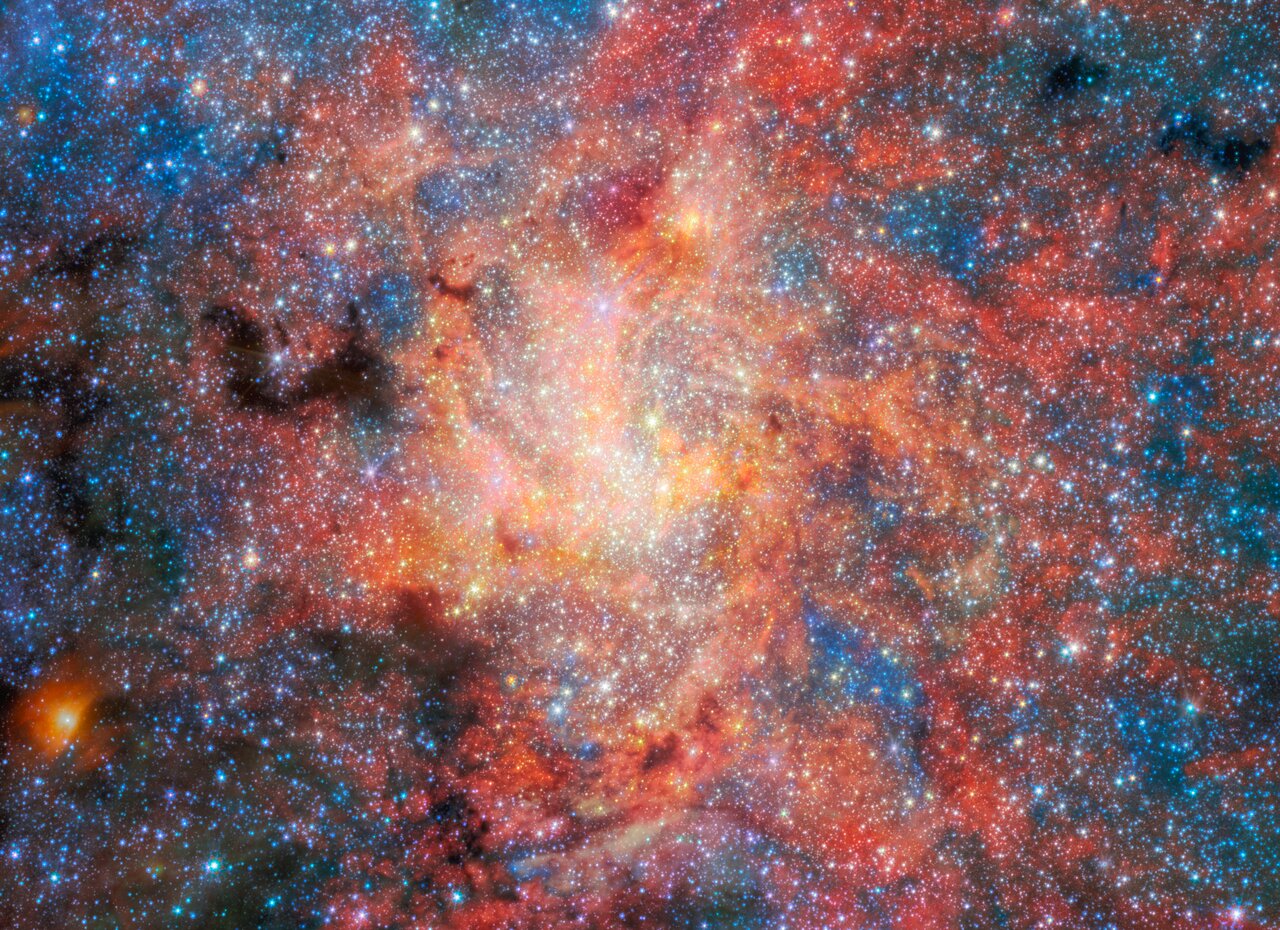
In August 2026, the James Webb Space Telescope observed something that no one would have thought possible just a few years ago: dust and water forming and surviving less than one light-year from the supermassive black hole at the center of our galaxy. The discovery was published in the journal *Astronomy & Astrophysics* by a team led by Florian Peissker of the University of Cologne.
The location: the center of the Milky Way
At the center of our galaxy lies Sagittarius A* (abbreviated Sgr A*), a supermassive black hole with a mass of 4.3 million solar masses. Surrounding it is an extreme environment: intense ultraviolet and X-ray radiation, temperatures reaching millions of degrees in the accretion disk, distorted magnetic fields, and stars orbiting at breakneck speeds.
A star called IRS 3 lives in this neighborhood. «IRS» stands for «Infrared Source.» IRS 3 is a star at the end of its life: it has burned through its hydrogen, has become a red giant, and is now shedding material into space. Its mass is about six times that of the Sun, and it is about 72 million years old. It is located just 0.55 light-years from Sgr A*—which is very close on a galactic scale.
How We Know It: Light as a Fingerprint
To understand how we can «see» dust and water around a star, we need to understand a simple principle of physics: each molecule absorbs and emits light at specific wavelengths, much like a unique fingerprint.
When starlight passes through the dust and gas surrounding it, certain colors (certain wavelengths) are absorbed by the molecules present. When we look at the spectrum of this light—just as when a prism splits white light into a rainbow—we see dips and peaks at specific positions. These dips and peaks tell us exactly which molecules are present.
The problem is that dust and water are only visible in the infrared spectrum—light that is too red for the human eye to see and is largely blocked by Earth’s atmosphere. This requires an infrared space telescope. That is exactly what the James Webb Space Telescope does with its MIRI (Mid-Infrared Instrument) instrument.
Webb pointed MIRI at IRS 3 and recorded the most detailed infrared spectrum ever obtained for this star. In this spectrum, the team identified two very clear infrared signatures associated with silicate dust—a type of dust composed of silicon and oxygen, the same kind found in sand on Earth. And for the first time for this object, they also detected the signature of water in the envelope surrounding the star.
What We Found
Observations reveal that IRS 3 is surrounded by a dust envelope consisting of successive layers, extending over approximately 10,000 astronomical units (1 astronomical unit = the distance from Earth to the Sun, or 150 million km). The temperature of this dust ranges from 1,200 kelvin near the star to about 100 kelvin in the outer regions. To give you an idea: 1,200 K is about 930°C—hot, but not hot enough to destroy the dust.
The dust is oxygen-rich (silicate), which contradicts previous studies that suggested IRS 3 was carbon-rich. This is a significant change: an oxygen-rich star produces different dust than a carbon-rich star, and this alters our understanding of what this star contributes to its environment.
As for water: this is the first clear detection of water molecules around IRS 3. The discovery is significant because water, like any molecule, can be destroyed by intense radiation. However, at a distance of 0.55 light-years from a supermassive black hole, radiation is exactly the kind of thing that should destroy the molecules.
Why is this surprising?
Imagine this: you are 0.55 light-years away from a supermassive black hole. The ultraviolet and X-ray radiation emitted by the accretion disk and the surrounding stars is intense. Temperatures in the immediate vicinity of the black hole reach millions of degrees. The magnetic fields are distorted and turbulent. As Florian Peissker describes it, this is «one of the most extreme environments» known to us.
In this environment, it was thought that dust and complex molecules could neither form nor survive. Radiation would break them down. High temperatures would vaporize them. Complex chemical reactions would be impossible.
However, Webb shows that this is not the case. IRS 3, a star at the end of its life, continues to produce dust and water 0.55 light-years from the black hole. And this dust and water survive. As Macarena Garcia Marin of ESA, a co-author of the study, summarizes: «The detection of water is particularly exciting because it shows that molecular material can survive in an environment dominated by intense radiation.»
Implications: The Resilience of Matter
This discovery has a simple yet profound implication: even in the most hostile environments in the universe, chemical processes continue. Stars at the end of their lives enrich the interstellar medium with dust and molecules, even near a black hole. And this dust is the raw material for future stars and planets.
Why is this important? Because dust is the building material for rocky planets like Earth. If dust can form and survive near a supermassive black hole, then it can form and survive almost anywhere. This means that the ingredients for forming rocky planets—and perhaps life—are more resilient than we thought.
Furthermore, this discovery changes our understanding of the chemistry of the galactic center. Galactic centers are the densest and most active regions of a galaxy. If stars can produce dust and water there, then these regions contribute to the galaxy’s material cycle in a much more significant way than previously thought.
And from Switzerland?
The center of the Milky Way is in the constellation Sagittarius. From Switzerland (latitude 47°N), it reaches its highest point about 14 degrees above the southern horizon—low, but visible on a clear night with an unobstructed horizon. The best time to observe it is from June through September, when Sagittarius is high in the night sky. By October, it is already low on the southwestern horizon at dusk.
With the naked eye, under a truly dark sky, you can see the milky band of the Milky Way stretching across Sagittarius—the brightest region in the entire sky, since you’re looking toward the center of the galaxy. Through binoculars, the density of stars in this region is staggering. And of course, you can’t see IRS 3 or Sgr A* —these are infrared and radio objects, invisible in visible light—but we now know that within this bright patch in Sagittarius, 26,000 light-years away from us, dust and water are forming silently, despite the black hole.
In a nutshell
The James Webb Space Telescope has detected, for the first time, silicate dust and water around the star IRS 3, located 0.55 light-years from the supermassive black hole Sgr A* at the center of the Milky Way. This discovery shows that even in one of the most extreme environments in the universe, the chemistry of matter continues—stars at the end of their lives still produce the dust that will form future generations of stars and planets.
The observations were obtained in 2025 as part of the MICONIC (Mid-Infrared Characterization of Nearby Iconic Galaxy Centers) program using Webb’s MIRI instrument, and published in *Astronomy & Astrophysics* on August 11, 2026.
Sources : ESA/Webb – Press Release, August 11, 2026 ; NASA – Image of the Day, September 10, 2026 ; Scientific Article – Astronomy & Astrophysics ; Space.com, September 23, 2026
See also on Deep Space Astronomy: Saturn in opposition on October 4, 2026 ; Deconvolution in Astronomy
Signature: CBurkhalter