When you start out in astrophotography, you’ll quickly hear about ZWO. That’s to be expected—ZWO is the market leader. But when you dig a little deeper, another name keeps coming up: Player One Astronomy. It’s a brand that has built its reputation on a combination of high-quality hardware, robust software, and responsiveness that makes all the difference on a daily basis. I love working with them—they’re incredibly responsive.
Positioning: From the Sensor to the Complete Setup
Player One Astronomy is a Chinese brand founded by engineers passionate about astrophotography. Unlike ZWO, which initially focused on planetary cameras before expanding, Player One has built its product line around a consistent approach: naming each product line after a celestial body in the Solar System (Mars for planetary cameras, Neptune for color cameras, Apollo for solar, Uranus for all-purpose, and Zeus for cooled deep-sky), and designing each camera for a specific purpose.
The current lineup covers the entire spectrum:
- Guidance : Ceres 462M (about 160 CHF), Xena 585M (about 320 CHF)
- Planetary : Mars 662M, Neptune 664C (about 250 CHF), Neptune-M
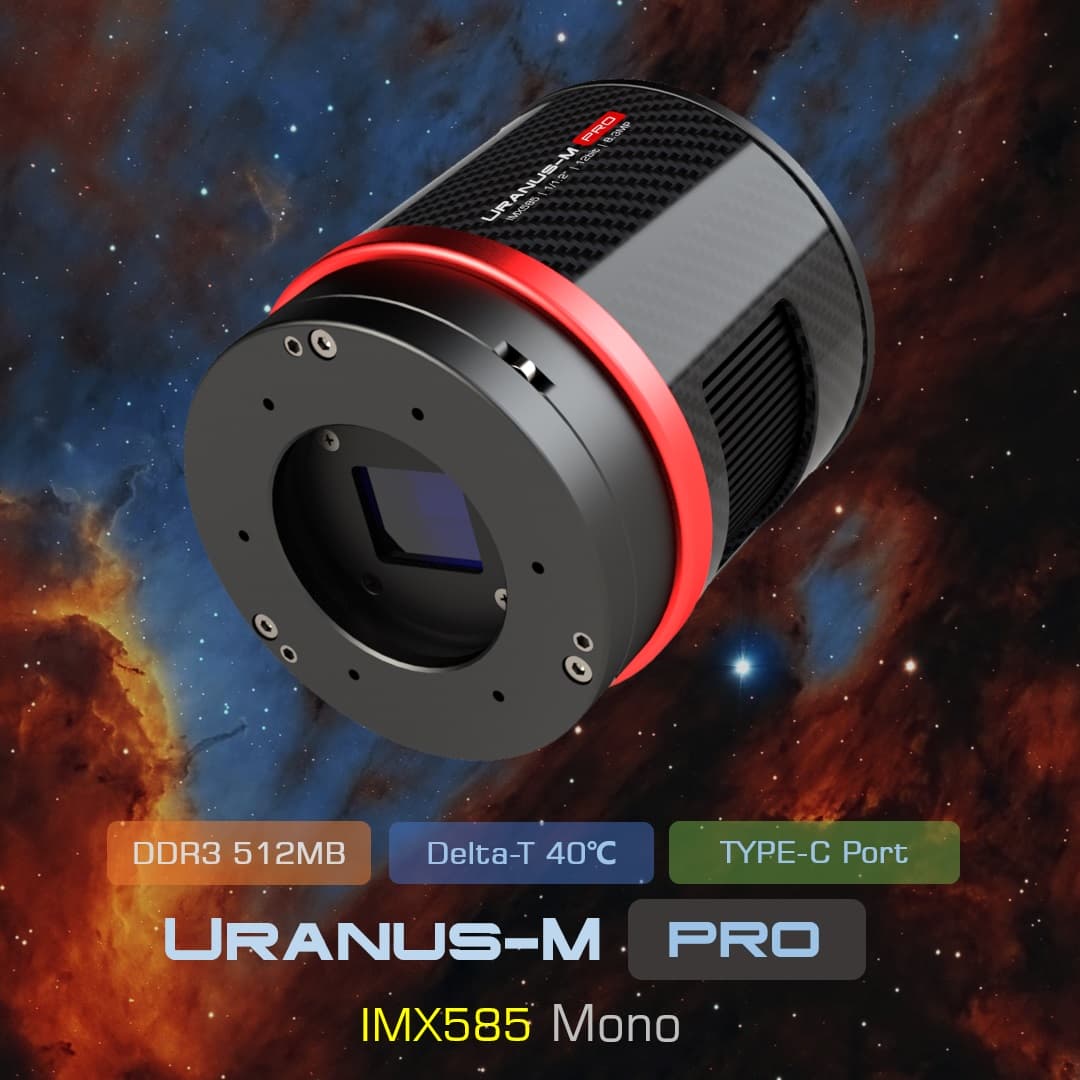
- Versatile DSO/Planetary : Uranus-M (IMX585, approximately 400 CHF), Uranus-M Pro (cooled) (approximately 590 CHF)
- Deep, Cool Sky : Artemis (IMX492/294), Poseidon (IMX571), Zeus 455 (IMX455, up to about 3,900 CHF)
- Solar : Apollo 428M MAX (IMX428, about 720 CHF), Apollo 428M MAX Pro (cooled), (about 900 CHF)
- Accessories : Phoenix 5×2 filter wheel, Anti-Halo PRO dual-band Ha-OIII filters
The catalog is comprehensive and consistent, and each product has a specific purpose. There is no unnecessary overlap.
Material benefits: what makes the difference
Build Quality
That’s the first thing users notice about Cloudy Nights: Player One cameras are better built than the competition. Machined aluminum chassis, high-quality connectors, and thoughtful heat dissipation. The Cloudy Nights forum puts it plainly: «Player One is much better built, has a better cooler, and Player One responds very quickly to emails.»
The built-in dew heater
This is a feature that many users mention: a built-in dew heater on the sensor. On cooled cameras (Uranus Pro, Poseidon, Zeus), the dew heater prevents dew from forming on the sensor window. ZWO offers a dew heater on certain models, but at Player One, it comes standard on the entire cooled lineup.
Why is this important? In deep-sky observing, sessions last for hours. Dew forms on any cold surface. A sensor cooled to -20°C is the coldest surface in the tube. Without a dew heater, dew builds up on the sensor window and ruins the session. Having a built-in dew heater that can be controlled via the software means one less thing to worry about.
Cooling
Player One uses TEC (thermoelectric) modules with a specified Delta-T. The Poseidon Pro achieves a Delta-T of 40°C below ambient temperature. The Zeus 455 Pro achieves 35°C. The Apollo 428M MAX Pro is cooled for solar applications, which is rare—most solar cameras are not cooled.
Thermal management isn't limited to the TEC. Player One has published a technical article on its «Passive Cooling System» (PCS): the chassis and PCB design are optimized to dissipate heat from the sensor and electronics without adding thermal noise. The 512MB DDR3 buffer memory on the Pro models reduces USB transfer times and the thermal load on the controller.
The DDR3 Buffer
All Player One cameras feature a DDR3 buffer (256 MB on planetary models, 512 MB on Pro models). This buffer allows images to be captured at high frame rates without saturating the USB bus, which prevents frame drops during planetary acquisition at 100+ FPS. On cameras without a buffer, frames may be lost during USB transfer spikes.
Software Benefits: Reliable Drivers and Compatibility
Native NINA Drivers
Player One provides proprietary drivers for NINA (Nighttime Imaging ‘N’ Astronomy), the leading image capture software for deep-sky photography. On Cloudy Nights, one user puts it plainly: «If you’re using Windows, it works perfectly with NINA via the proprietary drivers.»
NINA has become the standard for deep sky imaging, ahead of Sequence Generator Pro and MaxIm DL. Having stable native drivers for NINA is a major benefit for the community.
ASCOM Drivers
Player One also provides ASCOM (Astronomy Common Object Model) drivers, the Windows standard for controlling astronomical equipment. ASCOM drivers allow you to control cameras from any compatible software: PHD2 for guiding, SharpCap for planetary imaging, and FireCapture for solar imaging.
The ASCOM Player One driver was updated on May 1, 2026 (version 6.5.10.1), indicating that it is actively maintained.
Cross-platform SDK
Player One provides an SDK for Windows, Linux (x86_64 and ARM64), macOS, and even Raspberry Pi. This SDK allows developers to create third-party applications based on Player One cameras. Availability on Linux ARM64 and Raspberry Pi is a benefit for remote setups based on mini-computers (Stellarmate, Astroberry, INDI).
Player One Camera Software
Player One offers its own capture software, which is compatible with Windows, macOS, and Linux. For users who don't want to use NINA or SharpCap, it's a free and actively maintained alternative.
Responsiveness: The Service That Makes the Difference
This is where Player One really stands out. The forums are unanimous: Player One responds quickly to emails, resolves issues promptly, and continuously updates its drivers and software.
On Cloudy Nights, in the thread titled «Player One, QHY, or ZWO?,» the consensus is clear: «Player One responds to emails very quickly.» This has been corroborated by several independent users.
My experience: I love working with them. They’re incredibly responsive. When we have a technical question—about a driver, compatibility, or a setting—we send an email and get a response within the day, sometimes within an hour. For a brand based in China, that’s remarkable. The time difference should be an obstacle, but the Player One team responds during our European business hours, which suggests either a dedicated support team or a time zone adjustment.
This responsiveness is also evident in the updates: drivers are updated regularly (the latest version of the ASCOM driver is from May 2026, as is the SDK), new Sony sensors are integrated quickly, and bugs reported by the community are fixed.
Player One vs. ZWO: What's the Difference?
ZWO remains the market leader, and for good reason: the ASIAIR ecosystem (mobile app), hardware integration (mounts, filter wheels, coolers), and the size of its community. If you use ASIAIR, stick with ZWO—the ecosystem is closed.
But for users who prefer NINA on Windows or INDI on Linux, Player One offers a distinct advantage:
- Build Quality : superior, according to user feedback
- Built-in dew heater : Standard across the entire refrigerated line
- Native NINA Drivers : stable and up-to-date
- Cross-platform SDK : Linux ARM64, macOS, Raspberry Pi
- Responsiveness of Customer Support : quick responses, frequent updates
- DDR3 Cache : on all models
According to the specialized website Skies and Scopes, Player One accounts for approximately 29% of the cameras used by award-winning astrophotographers, compared to 35% for ZWO. Player One has even surpassed ZWO in certain price categories, driven by the popularity of the Uranus-C.
The recommended product line by use
For the planetary mixer
Visit Mars 662M (1/2.8″, IMX662, 256 MB DDR3) is the entry-level planetary camera. For more advanced users, the Neptune 664C (color, about 250 CHF) or the Neptune-M (mono) feature a larger sensor.
For solar energy
L’Apollo 428M MAX (IMX428, approximately 720 CHF) is an optimized monochrome solar camera. The Apollo 428M MAX Pro (approximately 900 CHF) adds TEC cooling, which is rare for a solar camera—the cooling reduces thermal noise during long solar sessions.
For the Deep Sky
L’Uranus-M (IMX585, approximately 400 CHF) is the versatile DSO/planetary camera. For cooled deep-sky imaging, the’Artemis Pro (IMX492/294) is the entry-level cooled model, the Poseidon Pro (IMX571) is the mid-range model, and the Zeus 455 Pro (IMX455 full-frame) is the top-of-the-line model.
For guidance
Visit Ceres 462M (about 160 CHF) is an affordable guiding camera with a 1/2.8″ IMX462 sensor that is sensitive to near-infrared light—ideal for guiding with faint reference stars.
In a nutshell
Player One Astronomy has won over astrophotographers with its build quality, built-in dew heater, stable NINA and ASCOM drivers, cross-platform SDK, and—above all—responsive technical support. The product line is well-rounded, ranging from guiding to full-frame cooled deep-sky imaging. For users of NINA on Windows or INDI on Linux, it’s a credible alternative to ZWO, with a clear advantage in hardware quality and service. I love working with them—they’re incredibly responsive, and that makes all the difference when you have a technical question right in the middle of a session.
Sources : Player One Astronomy – Official Website ; Cloudy Nights – Player One, QHY, or ZWO? ; Cloudy Nights – Player One Astro Cameras ; Skies and Scopes – ZWO Camera Comparison.
See also on Deep Space Astronomy: Barlow and backfocus ; Deconvolution in Astronomy
Signature: CBurkhalter