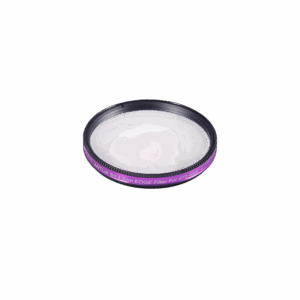
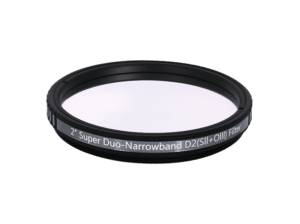
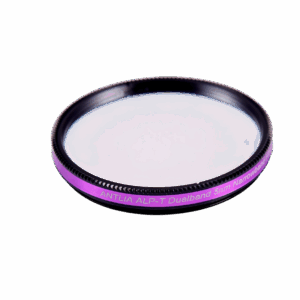
Baader Skyglow Neodymium: a versatile contrast filter for the Moon, planets and the deep sky
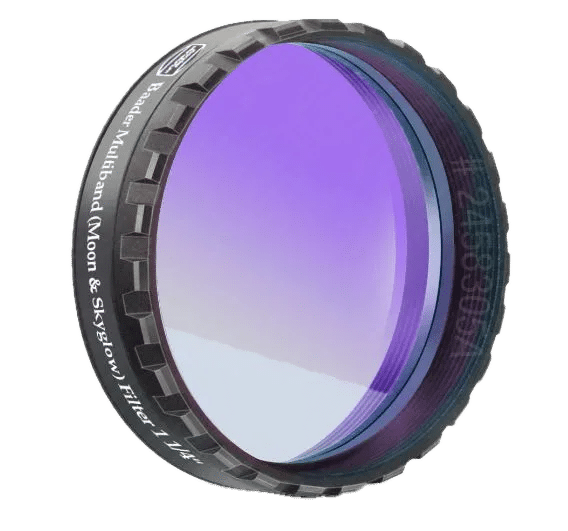
Visit Baader Skyglow Neodymium, also known as Moon & Skyglow Neodymium, is an astronomical filter designed to enhance visual contrast while preserving a natural image. Unlike many conventional color filters, it does not strongly tint the image. It acts selectively on certain troublesome wavelengths, notably those associated with light pollution and moonlight scattering.
Thanks to its neodymium-doped glass and multi-layer coating Phantom Coating Group, This filter provides a darker sky background, better-defined planetary details and improved separation of color shades. It is particularly appreciated for observing the Moonof Jupiterof March and Saturn, but can also be useful on certain bright deep-sky objects.
An excellent filter for lunar and planetary observation
On the Moon, Baader Skyglow Neodymium helps reduce glare while enhancing the contrast of lunar seas, craters and relief. The image remains bright, but becomes more comfortable to observe, especially with medium to large telescopes.
In planetary images, the filter enhances the perception of subtle details. On Jupiter, It can enhance the visibility of cloud bands and the Great Red Spot. On March, It helps to bring out dark surface areas and reddish-orange nuances more effectively. The main benefit is to gain contrast without obtaining an artificially colored image.
Selective reduction of light pollution
Skyglow Neodymium is not as radical an anti-light pollution filter as a UHC filter or a narrow-band filter. Its role is more subtle: it attenuates certain undesirable wavelengths, particularly in areas of the spectrum where urban lighting and sky brightness can hamper observation.
This makes it a very interesting filter for astronomers observing from a garden, terrace or peri-urban area, while still wishing to retain a natural, versatile image.
Compatible with visual observation and imaging
The Baader Skyglow Neodymium filter can be used for visual observation with an eyepiece, as well as for lunar and planetary imaging, and even for certain photographic applications. It also incorporates a UV/IR cutoff, useful for improving sharpness with certain infrared-sensitive cameras.
Its high-quality optical polish means it can be used at high magnification, including for demanding planetary observation, without unnecessarily degrading image sharpness.
Highlights
- Improves contrast on the Moon and planets
- More natural image than with many color filters
- Enhanced detail on Jupiter and Mars
- Reduces certain wavelengths associated with light pollution
- Neodymium-doped glass
- Phantom Coating Group multilayer treatment
- Integrated UV/IR filter
- For visual and imaging applications
- Suitable for telescopes, spotting scopes and Maksutov/Schmidt-Cassegrain telescopes
For what uses?
| Moon |
Reduced glare and improved contrast of lunar features. |
| Jupiter |
Better perception of cloud bands and the Great Red Spot. |
| March |
Enhanced surface detail and reddish tones. |
| Saturn |
Slightly improved contrast on the globe and rings. |
| Brilliant deep sky |
Can help to slightly darken the sky background on certain bright objects. |
| Planetary imaging |
Useful filter thanks to its selective transmission and UV/IR cut-off. |
Technical specifications
| Brand |
Baader Planetarium |
| Filter type |
Contrast filter / Moon & Skyglow / bandpass |
| Glass |
Neodymium-doped optical glass |
| Treatment |
Phantom Coating Group |
| Use |
Moon, planets, contrast, light pollution reduction, imaging |
| UV/IR cut-off |
Yes |
| Filter thickness |
Approx. 1 mm outside the cell |
| Available formats |
Depending on version: 1.25″, 2″ or other Baader-compatible formats |
Our opinion
Visit Baader Skyglow Neodymium is one of the most interesting filters for beginning contrast enhancement in visual observation. It doesn't radically transform the image, but provides a subtle, clean and pleasing gain, particularly on the Moon and planets. It's an excellent choice for observers who want a versatile filter that can be used regularly, without over-coloring the image.
For a Dobson, Schmidt-Cassegrain, Maksutov or astronomical telescope, this is a simple, durable and very useful accessory to keep in your observation case.