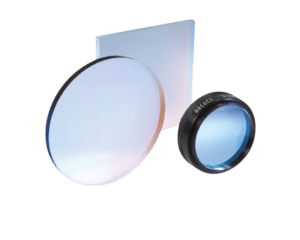
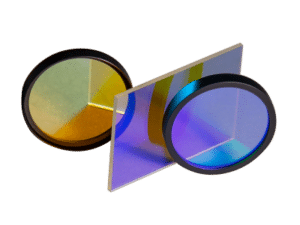
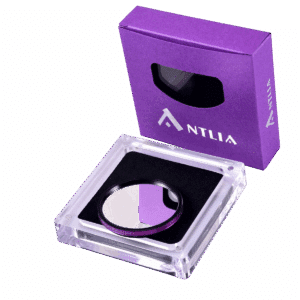
Chroma 5nm H-alpha filter
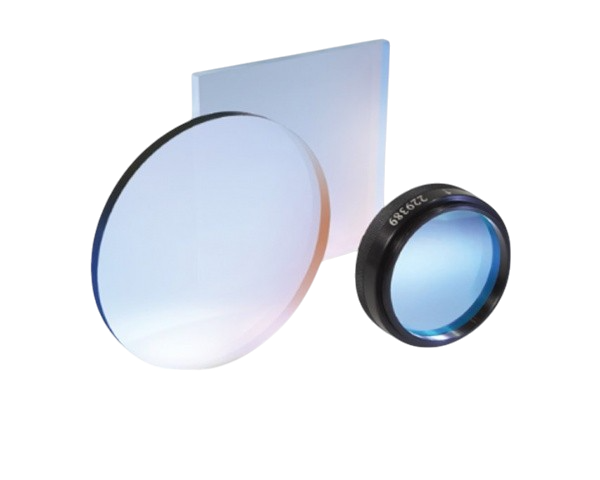
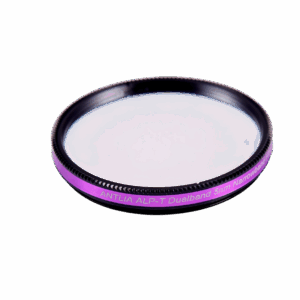
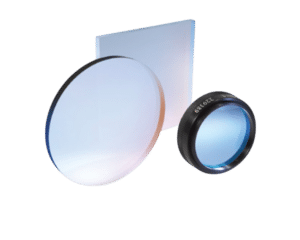
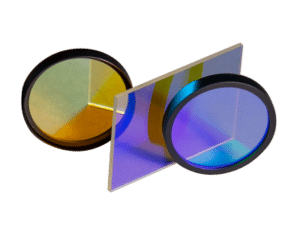
The filter H-alpha 5nm from Chroma is a narrow-band filter designed for imaging nebulae and other objects rich in ionized hydrogen. With a bandwidth centered on the H-alpha line at 656.3 nm, it offers exceptional performance for astrophotography, particularly in environments subject to heavy light pollution.
Key features
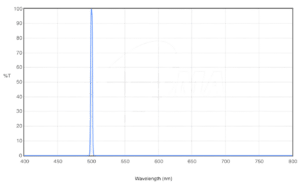
- Bandwidth : 5 nm, enabling precise isolation of the H-alpha line while suppressing unwanted wavelengths such as those of sodium or mercury vapor lamps.
- High transmission : Up to 90 % at 656.3 nm, guaranteeing an excellent signal-to-noise ratio.
- Optical quality :
- Surface polished to an accuracy of λ/4.
- Multilayer anti-reflective coating on both sides to prevent halos and stray reflections.
- Available formats :
- 1.25" (mounted)
- 2" (mounted)
- 31 mm and 36 mm (unmounted)
- Substrate thickness : Approx. 3 mm ±0.05 mm.
- Parallelism : < 30 arcsec, guaranteeing optimum image quality.
Applications
- Imaging emission nebulae :
- Perfect for capturing HII regions rich in ionized hydrogen.
- Recommended for planetary and diffuse nebulae.
- Reducing light pollution :
- Ideal for astrophotographers working in urban or suburban areas.
- Compatibility with high-speed systems :
- Optimized for focal ratios up to f/4.0. For faster systems (f/2.6 to f/3.6), we recommend using the “High-Speed” version to compensate for the blueshift.
Technical advantages
- Exceptional durability :
- Manufactured with sputter coatings on a single high-quality optical glass substrate, eliminating the need for laminations.
- The filters are resistant to extreme variations in temperature and humidity, guaranteeing long-term spectral stability.
- Anti-halos design : Anti-reflective coatings eliminate halos around bright stars and maximize light transmission.
- Easy orientation : An arrow on the edge of the filter indicates the correct direction to minimize autofluorescence and maximize performance.
Conclusion
The filter Chroma H-alpha 5nm is a top-of-the-range choice for astrophotographers wishing to capture detailed, high-contrast images of the deep sky. Its optical precision, high transmission and ability to effectively reduce light pollution make it an indispensable tool for professional or advanced amateur imaging.