Which telescope should you choose to get off to a good start in astronomy in Switzerland? The choice depends mainly on your goals: observing the Moon and the planets, exploring deep-sky objects, having a compact instrument, or getting into astrophotography.
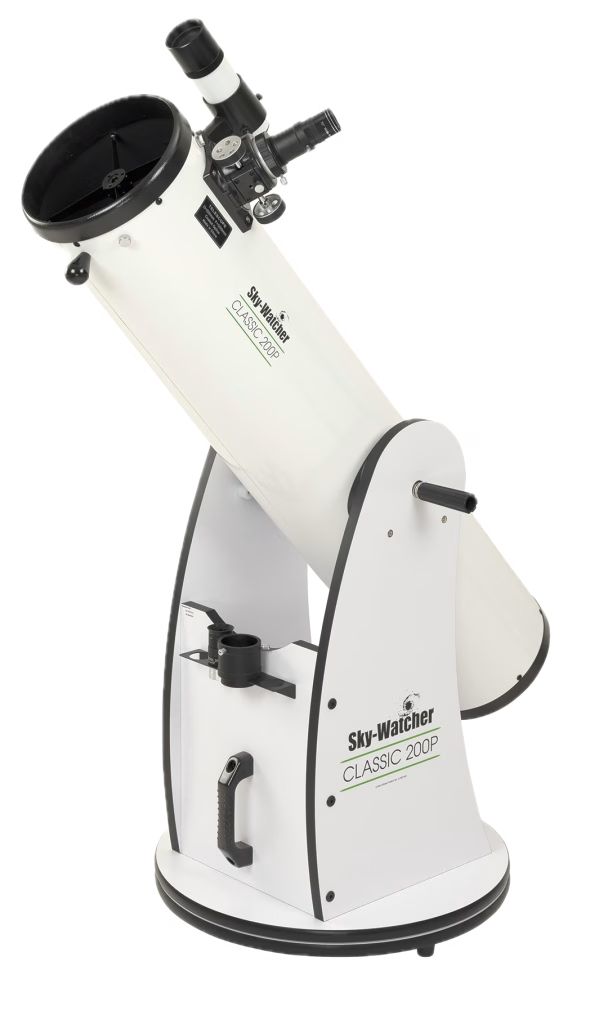
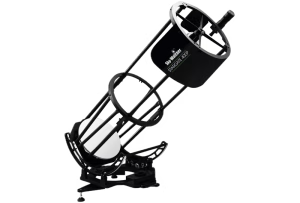
For visual observation, the Dobsonian remains our top recommendation. Its simple mount allows you to allocate a large portion of your budget to the mirror’s diameter. This gives you more light, greater detail, and a durable instrument at a reasonable price.
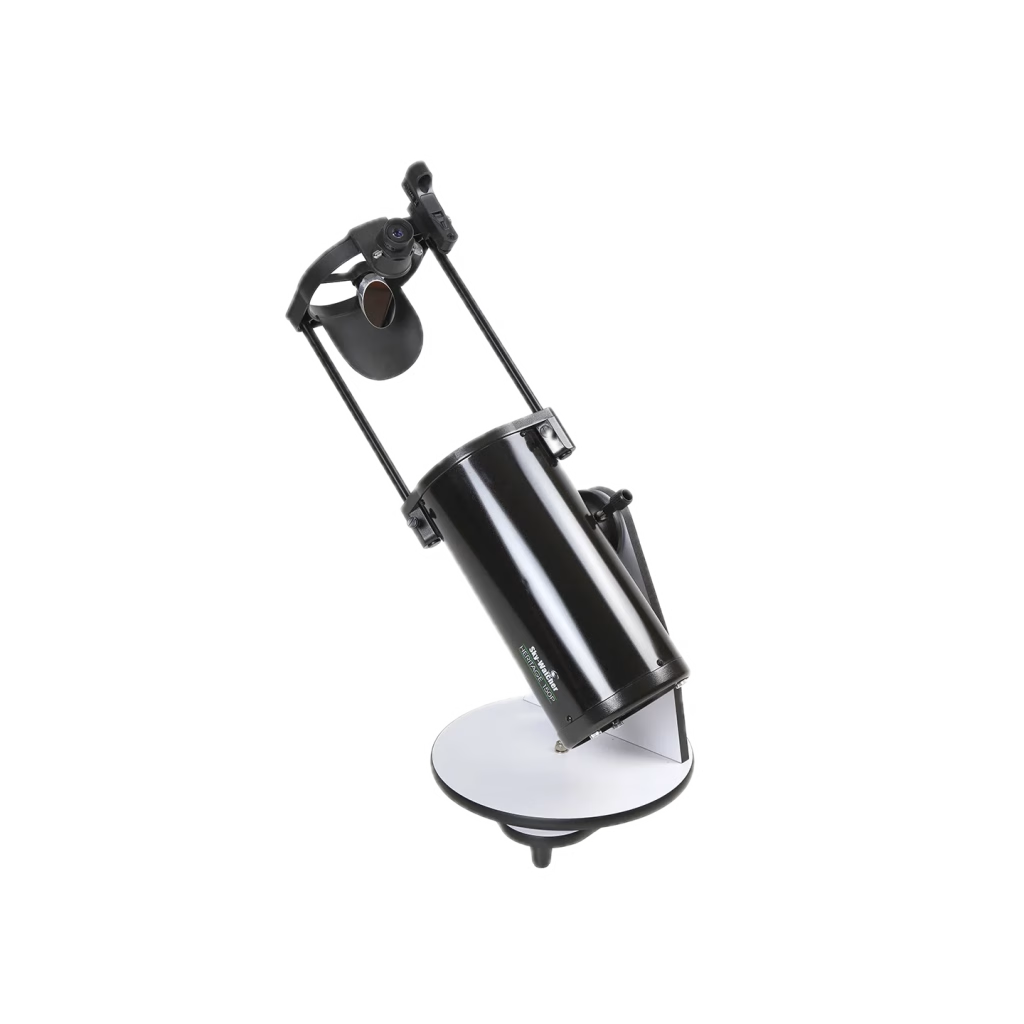
Keep in mind, however, that a Dobson telescope is relatively bulky. You’ll often need a car to reach a darker sky, and you’ll need to set aside storage space at home. If space is limited, a foldable Dobson Heritage or a Maksutov-Cassegrain is an excellent alternative.
With this telescope, you’ll be able to observe the lunar craters, Jupiter’s cloud bands, Saturn’s rings, star clusters, numerous nebulae, and several galaxies. Under a dark sky, the 200-mm aperture is already sufficient to explore a large portion of the Messier catalog.
The Skyliner 200 mm is operated entirely by hand. It has neither a motor nor a GoTo system, but its Dobsonian mount is intuitive and quick to set up. This simplicity is also an advantage: it allows you to learn how to find your way around the sky while avoiding power and electronics issues.
Upgrade to a 250 mm Dobsonian
If you have a vehicle, enough storage space, and a more generous budget, a 250-mm diameter telescope represents a real leap forward in observation.
The 254-mm mirror collects significantly more light than a 200-mm model. Globular clusters begin to resolve more easily into stars, nebulae reveal more detail, and galaxies become more prominent under clear skies.
This improvement in performance comes at the cost of increased weight and bulk. The tube measures about 1.2 m, and the entire assembly weighs nearly 28 kg. Transporting and collimating the telescope therefore requires a little more planning.
The Best Compact Telescopes for Kids and Small Spaces
For observing with children, traveling, or easily storing the telescope in an apartment, the Sky-Watcher Heritage 130P FlexTube is one of our favorite models.
Its collapsible tube, 130-mm parabolic mirror, and 650-mm focal length make it a simple, bright, and easy-to-transport instrument. It provides excellent views of the Moon and the planets, while also allowing you to observe the brightest deep-sky objects.
Visit Sky-Watcher Heritage 150P It provides more light while remaining compact. Its 150-mm diameter makes it an excellent balance between portability and performance.
To take advantage of automatic check-in and motorized tracking, the Sky-Watcher Heritage 150P Virtuoso GTi is particularly interesting. It is controlled from a smartphone using the SynScan app and can automatically point to thousands of celestial objects.
The Freedom-Find system also allows you to move the telescope manually without losing its alignment. This combination is very convenient for family use. The tracking system is suitable for planetary observation and short-exposure imaging, but it is no substitute for an equatorial mount for long exposures of the deep sky.
Which telescope should I choose for my balcony?
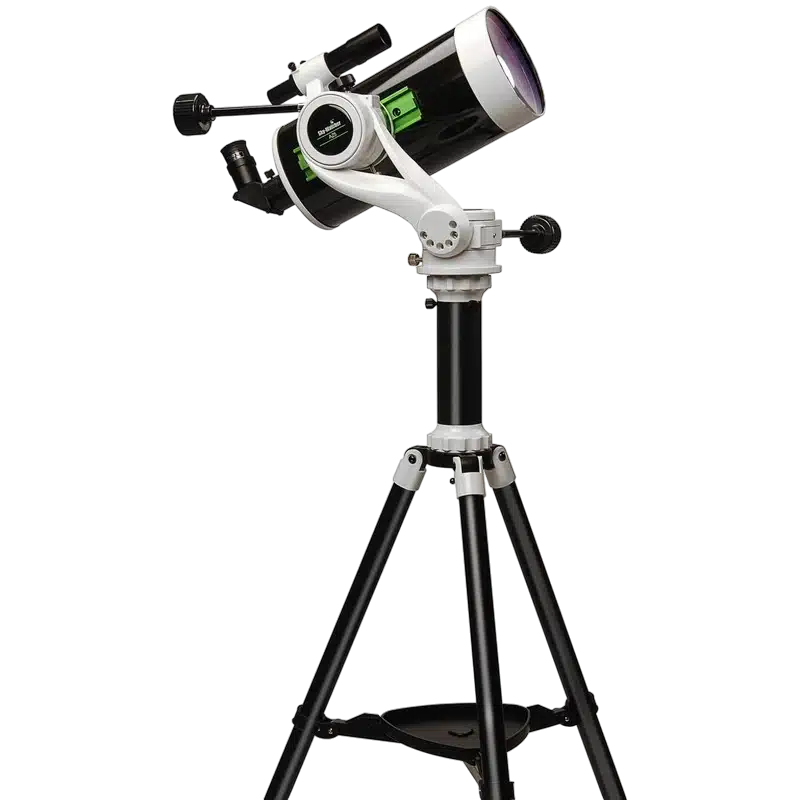
When space is limited, a Maksutov-Cassegrain telescope is an excellent solution. This optical design packs a long focal length into a very short tube. It produces high-contrast images and is particularly well-suited for observing the Moon, the planets, and double stars.
Visit Sky-Watcher Skymax 127 AZ-Go2 Wi-Fi is our most affordable compact model. Its 1,500-mm focal length makes high magnifications easy, while the GoTo mount allows for pointing and tracking via a smartphone.
Visit Sky-Watcher Skymax 150 PRO It offers higher resolution and brightness for discerning planetary observers. It is an optical tube only, so you’ll need to pair it with a sufficiently stable mount.
Visit Sky-Watcher Skymax 180 PRO is an instrument designed specifically for high-resolution planetary and lunar observation. Its diameter and long focal length can produce exceptional images, but the tube requires a sturdy mount and more time to reach ambient temperature.
The 127-mm Maksutov telescopes offered by Bresser are also excellent options. They can be mounted on a simple azimuth mount or a motorized mount, depending on your budget and the level of automation you desire.
Which telescope should I choose for observing and astrophotography?
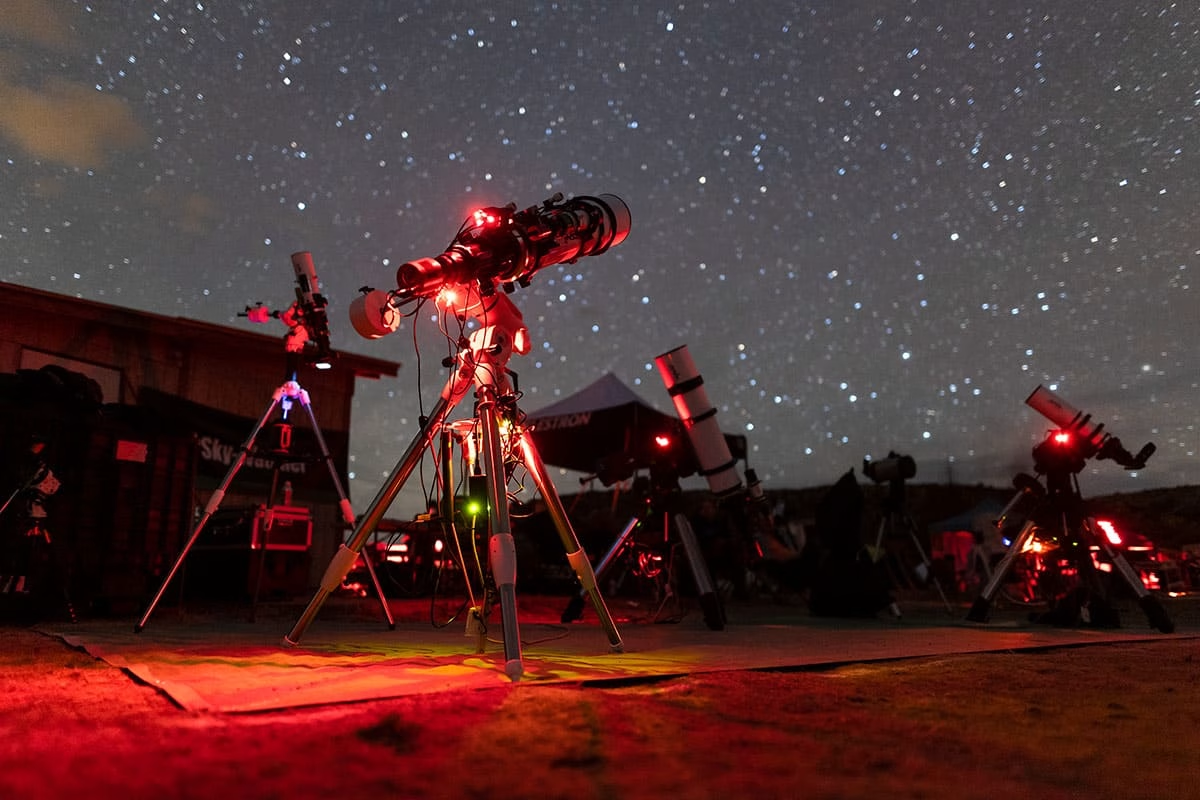
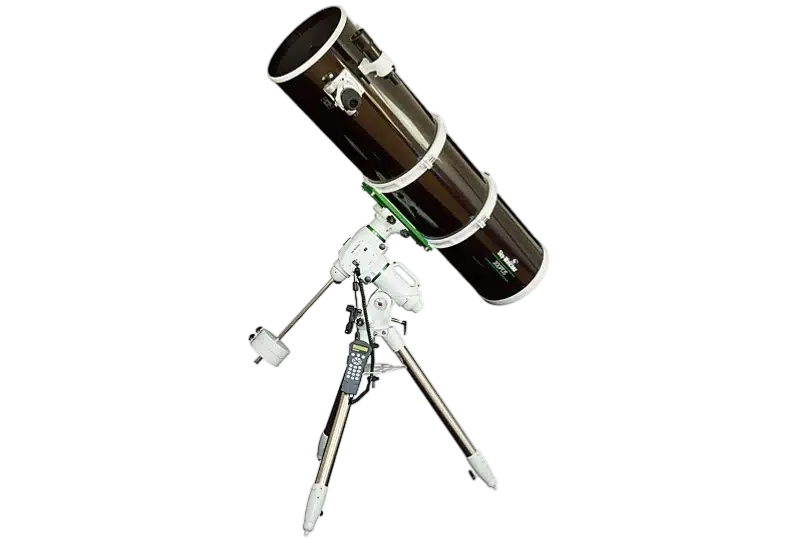
The Newtonian telescope has a 200-mm mirror and a focal length of 1,000 mm. It gathers enough light to provide excellent visual observations. The motorized equatorial mount provides the tracking necessary for deep-sky astrophotography.
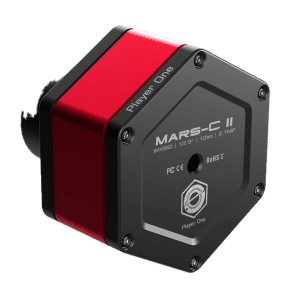
To take photographs with this telescope, you’ll need a suitable camera, a coma corrector, and a guiding system. The 200 mm tube is still relatively heavy and susceptible to wind. A 150-mm Newtonian is easier for a first attempt at long-exposure photography, while the 200PDS offers more light and long-term possibilities.
A Complete Setup for Getting Started with Deep-Sky Astrophotography
For a setup dedicated entirely to astrophotography, a harmonic mount paired with a small apochromatic refractor provides a modern, portable, and easy-to-automate foundation.
Visit Askar 71F Flat-Field APO Telescope is particularly interesting. This 71-mm quadruplet telescope has a focal length of 490 mm and a built-in field corrector. It therefore does not require an additional field corrector and is well suited for observing large nebulae, clusters, and extended galaxies.
A filter drawer allows you to add a filter suitable for nebulae and light pollution. When using a color camera, we recommend a Antlia ALP-T Dualband 5 nm H-alpha and OIII filter. It simultaneously captures the two main emissions from the nebulae while significantly reducing light pollution.
A 3-nm H-alpha filter used on its own is most suitable for a monochrome camera. For a color camera, the H-alpha and OIII dual-band filter makes better use of the sensor array and simplifies image acquisition.
The system can be controlled using an onboard computer such as the ToupTek StellaVita. It centralizes control of the mount, the main camera, the guide camera, the wheel or filter drawer, and the focusing system.
Finally, you'll need a guiding system for long exposures. An optical splitter is a very precise solution, but a small guide scope paired with a guide camera can also work very well for beginners.
Practical Tips for Birdwatching in Switzerland
Before buying a Dobsonian telescope, measure the available space in your vehicle and at home. A 200- or 250-mm tube is easy to use once it’s set up, but you’ll need to plan ahead for transporting it.
The quality of the sky is just as important as the diameter. Moving a few dozen kilometers away from large cities can reveal more detail than a small increase in diameter when observing from a very brightly lit balcony.
In the mountains and on humid nights, be mindful of condensation. An anti-fog device, a heating element, and a 12-volt battery are especially useful with a Maksutov, a telescope, or an astrophotography setup.
The used market can offer some great opportunities. For a manual Dobsonian, be sure to check the condition of the mirrors, the smoothness of movement, the eyepiece holder, and the accessories. For a motorized mount, also test the motors, the power supply, and the tracking.
Frequently Asked Questions About Choosing a Telescope
What is the best telescope for beginners in Switzerland?
For visual observation, our first choice is the Sky-Watcher Skyliner 200 mm Dobsonian. It features a large diameter, is easy to use, and offers an excellent balance of performance and value.
Should you choose a GoTo telescope when you're just starting out?
GoTo isn't essential. A manual Dobsonian telescope lets you learn about the sky and allows you to allocate almost your entire budget to the optics. GoTo becomes useful for family observing, automatically tracking a planet, or finding objects more easily under a city sky.
Can you do astrophotography with a Dobson?
A Dobsonian telescope allows you to photograph the Moon and the planets with a smartphone or a planetary camera. For long-exposure deep-sky photography, you'll need a motorized equatorial mount, a guiding system, and a suitable camera.
Which telescope should you choose if you're short on space?
The Heritage 130P and Heritage 150P are excellent choices for small spaces. If you're mainly interested in observing the Moon and the planets from a balcony, the Skymax 127 is even more compact.
How much money should you set aside to get started?
A good entry-level visual telescope starts at around CHF 250. A 200-mm Dobsonian costs around CHF 500. For a versatile setup on an equatorial GoTo mount, you should budget about CHF 1,700 before adding the camera, corrector, and guide scope.
Our Final Recommendation
If you're looking for your first real telescope to observe the sky, choose the Sky-Watcher Skyliner 200 mm Classic Dobsonian Telescope. It will help you learn about the sky, observe many celestial objects, and continue to grow as an astronomer for several years.
Choose a 250-mm diameter if transport and storage aren’t an issue. Opt for a Heritage 130P or 150P if compactness is your priority. For planetary observation on a balcony, the Skymax 127 is an excellent choice. For astrophotography, start by investing in a precise equatorial mount and a well-matched optical system.
Are you still trying to decide between several models? Contact Deep Space Astronomy for personalized advice depending on your budget, the space you have available, and your goals for observing or astrophotography.
Suggested retail prices as of August 19, 2026, and subject to change based on inventory and promotions. Never point a telescope at the Sun without a certified solar filter attached to the aperture.
To provide the best experiences, we use technologies such as cookies to store and/or access device information. Consenting to these technologies will allow us to process data such as browsing behavior or unique IDs on this site. Failure to consent or withdrawal of consent may adversely affect certain features and functions.
Functional
Always active
Storage or technical access is strictly necessary for the legitimate purpose of enabling the use of a specific service explicitly requested by the subscriber or user, or for the sole purpose of transmitting a communication over an electronic communications network.
Preferences
Storage or technical access is necessary for the legitimate purpose of storing preferences not requested by the subscriber or user.
Statistics
Storage or technical access used exclusively for statistical purposes.Storage or technical access which is used exclusively for anonymous statistical purposes. In the absence of a subpoena, voluntary compliance by your Internet service provider or additional third-party records, information stored or retrieved for this sole purpose generally cannot be used to identify you.
Marketing
Storage or technical access is necessary to create user profiles in order to send advertisements, or to track the user on a website or on several websites with similar marketing purposes.