If you do narrowband astrophotography with a color camera (OSC), you’re familiar with the problem: halos around bright stars. These bright rings—sometimes colored, sometimes disproportionately large—ruin an image that’s otherwise well-exposed. And if you’ve ever used Optolong filters, you know exactly what I’m talking about.
Recently, a customer switched from an Optolong filter to an Antlia filter. The difference in results speaks for itself.
The Problem with Halos: Why It Happens
A halo is a ring of diffuse light that surrounds a bright star in an astrophotographic image. The phenomenon occurs when light from a very bright star passes through a narrowband filter and some of that light is reflected or scattered within the filter itself, rather than being properly transmitted or blocked.
The mechanism works as follows: light from the star enters the filter. Some of it is transmitted (which is what we want). But another portion may be reflected between the filter’s various coating layers, or between the filter’s surface and the camera’s sensor. These internal reflections create concentric circles of light around the star.
Not all narrowband filters perform equally well when it comes to this issue. The quality of the coating, the parallelism of the glass surfaces, the number of dielectric layers, and the precision of manufacturing all determine the extent of the halos. This is where the differences between brands become apparent.
Optolong: the gold standard, but with halos
Optolong is the best-known brand in narrowband astrophotography. Their L-eNhance, L-eXtreme, and L-Ultimate filters are ubiquitous in the community. They are affordable, widely available, and offer good transmission performance.
But the topic of halos keeps coming up on forums. On Cloudy Nights, in the thread «L-Ultimate vs. ALP-T,» a user asks point-blank: «What’s the deal with halos?» It’s become a standard question in the community.
Halo effects with Optolong typically appear around very bright stars (magnitude 0 to 3). The L-eNhance, with its relatively broad bands (H-alpha at 10 nm, OIII at 24 nm), produces moderate halo effects. The L-eXtreme (7 nm) and the L-Ultimate (3 nm) reduce halos compared to the L-eNhance, but do not eliminate them completely.
The most commonly reported issue with Optolong is «star bloat»: stars appear bloated, larger than they should be, especially in the OIII channel. On forums, you’ll see comments like «Antlia has better control over star bloat» or «halos seemed to be present with the Ultimate.».
Antlia: A Different Approach
Antlia Filter is a brand that has gained an increasingly prominent position in the narrowband filter market. Their ALP-T (Antlia Low Pass Transmission) line is designed specifically for astrophotography with color cameras (OSC), but also works with monochrome cameras.
The key difference from Optolong lies in the filter coatings. Antlia uses a process for depositing dielectric layers on quartz glass, with stricter parallelism control. The filter surfaces are flatter, which reduces internal reflections and, consequently, halos.
On Facebook, in the ZWO ASI Users group, the consensus is clear: «In my experience, the ALP-T has better control over star bloat.» « And on Cloudy Nights, in the comparison between the L-Ultimate and the ALP-T: »Antlia handles star bloat better.”
The Testimonial: From Optolong to Antlia
A Deep Space Astronomy customer recently switched from an Optolong filter to an Antlia ALP-T filter. The following images show the results.
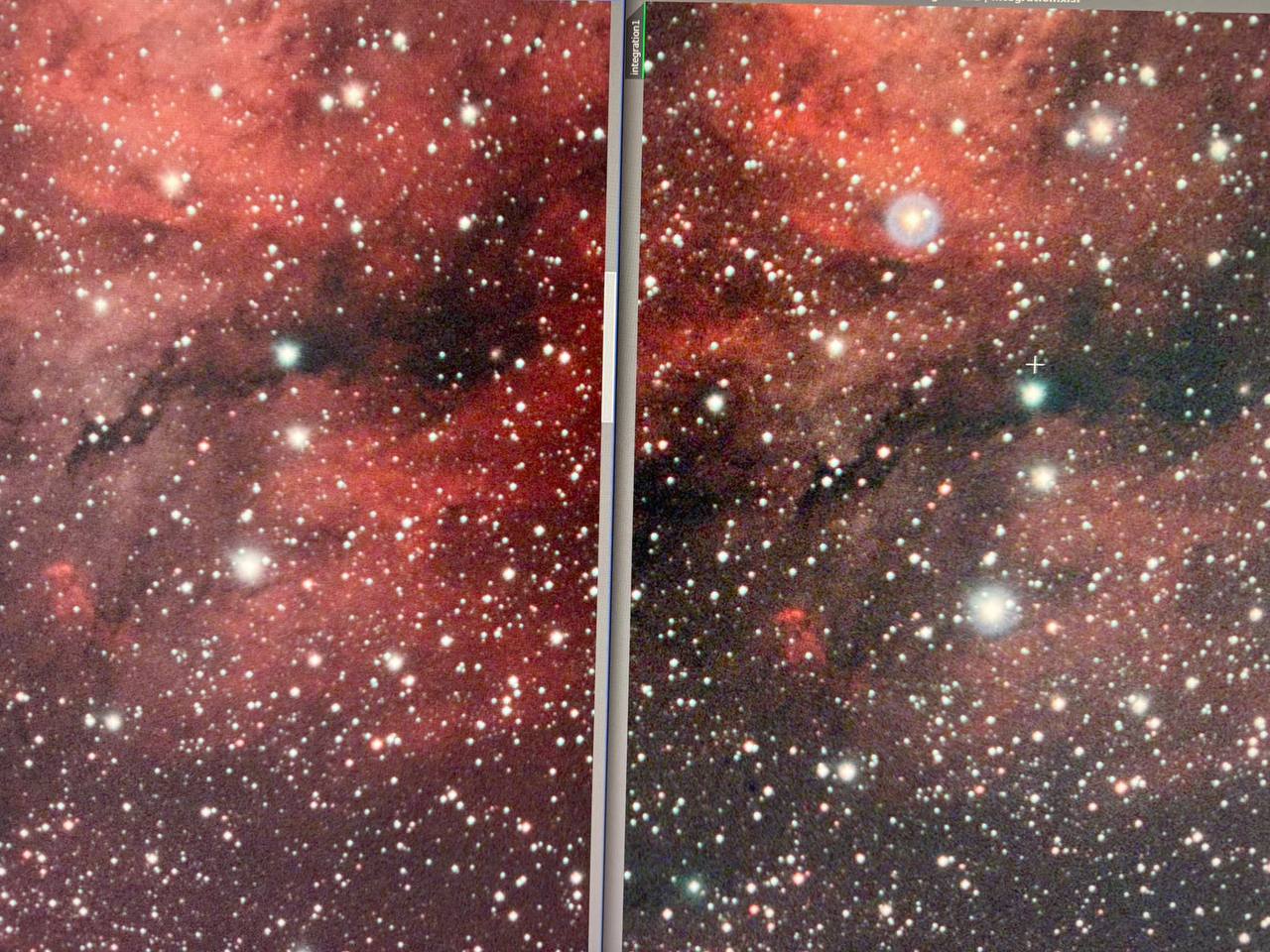
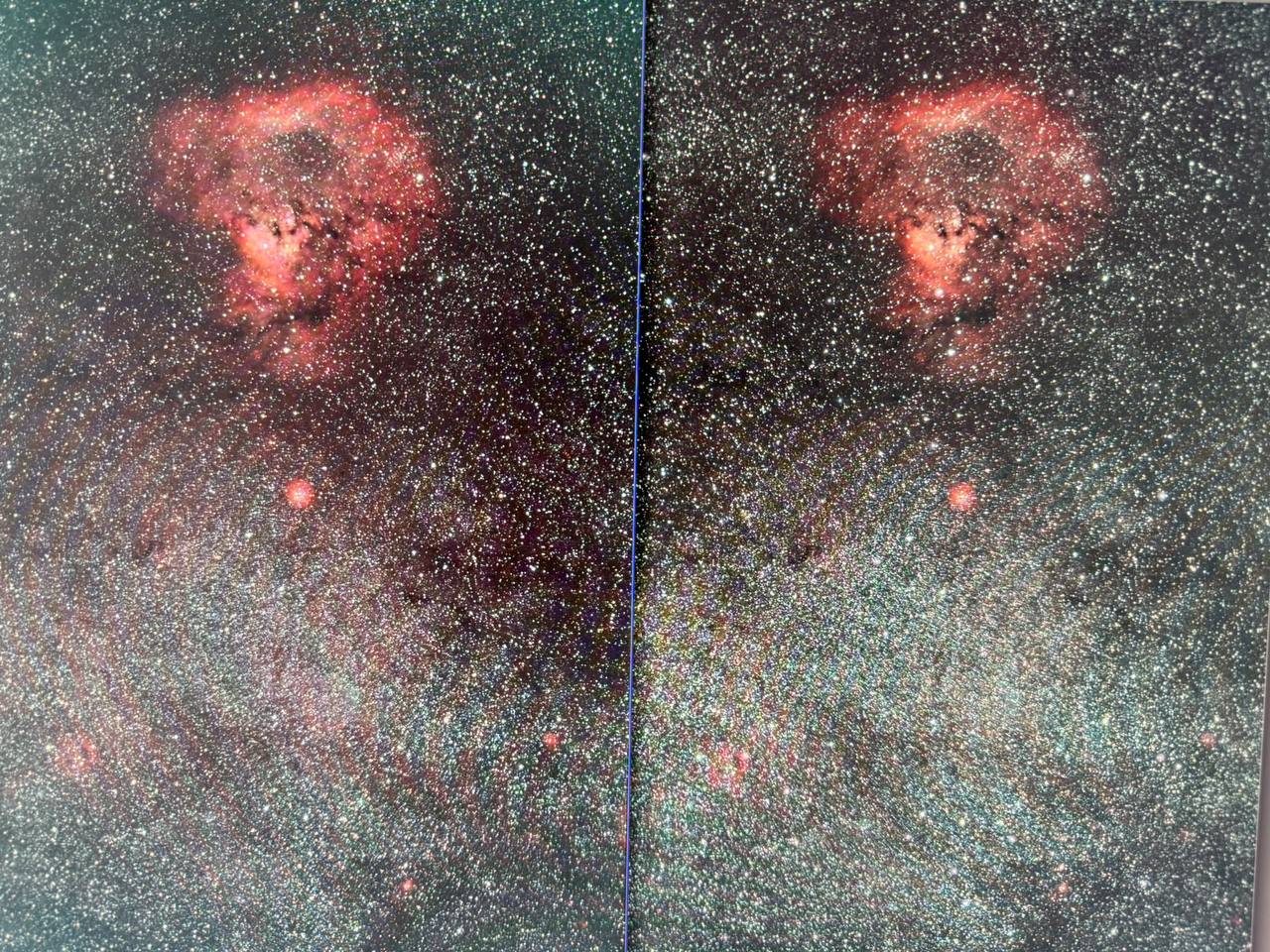
The North America Nebula (NGC 7000), photographed with an Optolong filter. The halos around the bright stars are visible. Image: Deep Space Astronomy client.
Before (Optolong) : The North America Nebula (NGC 7000) in Cygnus, photographed with an Optolong filter. The image shows a well-captured red H-alpha nebula, but the bright stars exhibit visible halos: diffuse rings around the brightest stars, particularly in the area of Deneb. The contrast between the nebula and the sky background is good, but the halos are distracting.
After (Antlia ALP-T) : The same nebula, photographed with an Antlia ALP-T filter. The stars are sharp and well-defined, with no visible halos. The nebula has greater contrast, and the fine structures of the Pelican Nebula (IC 5070) are more clearly defined. The result speaks for itself: the stars are points, not rings.
The difference isn't subtle. It's obvious at first glance, and it becomes more apparent with each new image.
Antlia ALP-T Filters: Which Version Should You Choose?
Antlia offers two main versions of its ALP-T filters: the standard series and the Highspeed series. The difference lies in the telescope's focal ratio.
The Standard Series (ALP-T Dualband)
The standard series is designed for telescopes with a focal ratio of f/4 or slower (f/5, f/6, f/7, etc.). This covers the majority of setups: apochromatic refractors, f/5 Newtonian telescopes, and f/10 Schmidt-Cassegrain telescopes.
Standard ALP-T filters are available in 3 nm and 5 nm:
ALP-T 3 nm Ha and OIII : ultra-narrow band, maximum contrast, ideal for use in areas with severe light pollution
ALP-T 5 nm Ha and OIII : slightly wider band, stronger signal, ideal under moderately light-polluted skies
The Highspeed Series (ALP-T Highspeed)
The Highspeed series is designed for telescopes with very fast focal ratios: f/2.2 to f/4. Hyperstar, Reducer, and very fast refractors. At these focal ratios, light rays arrive at a steep angle, which shifts the filter’s central wavelength (a phenomenon known as spectral shift depending on the angle of incidence). Highspeed filters have a pre-shifted central wavelength (CWL) to compensate for this shift and maintain optimal transmission.
The bandwidth (FWHM) determines how much light is transmitted around the emission line. The narrower the band, the more light pollution the filter blocks, but the less signal gets through.
3 nm : Maximum contrast, ideal for urban areas (Bortle 7–8). The nebula stands out against a black background. However, the signal is weaker, so longer or more frequent exposures are needed.
5 nm : no signal—ideal for suburban areas (Bortle 5–6). The nebula is brighter, but the sky background is less dark. This is the best compromise for most setups.
If you're new to narrowband imaging with a color camera, 5 nm is the recommended starting point. 3 nm is for advanced users who want to maximize contrast under a light-polluted sky.
The Verdict
Halo control is a key factor in choosing between Antlia and Optolong. Feedback from the community is consistent: the Antlia ALP-T offers better control of halos and star bloat than Optolong, thanks to a higher-quality coating and tighter surface parallelism.
This isn’t a marketing ploy. It’s a difference you can see in the images, as demonstrated by the testimonial from our customer who switched from Optolong to Antlia. The stars are sharp, the nebula has greater contrast, and post-processing time is reduced: fewer star masks to correct, fewer halos to reduce.
If you're using an Optolong and halos are frustrating you, switching to the Antlia ALP-T is a practical solution. And if you're just getting started with narrowband, Antlia is a choice that will prevent you from running into the halo problem later on.
To provide the best experiences, we use technologies such as cookies to store and/or access device information. Consenting to these technologies will allow us to process data such as browsing behavior or unique IDs on this site. Failure to consent or withdrawal of consent may adversely affect certain features and functions.
Functional
Always active
Storage or technical access is strictly necessary for the legitimate purpose of enabling the use of a specific service explicitly requested by the subscriber or user, or for the sole purpose of transmitting a communication over an electronic communications network.
Preferences
Storage or technical access is necessary for the legitimate purpose of storing preferences not requested by the subscriber or user.
Statistics
Storage or technical access used exclusively for statistical purposes.Storage or technical access which is used exclusively for anonymous statistical purposes. In the absence of a subpoena, voluntary compliance by your Internet service provider or additional third-party records, information stored or retrieved for this sole purpose generally cannot be used to identify you.
Marketing
Storage or technical access is necessary to create user profiles in order to send advertisements, or to track the user on a website or on several websites with similar marketing purposes.