CHF 1'299
Out of stock

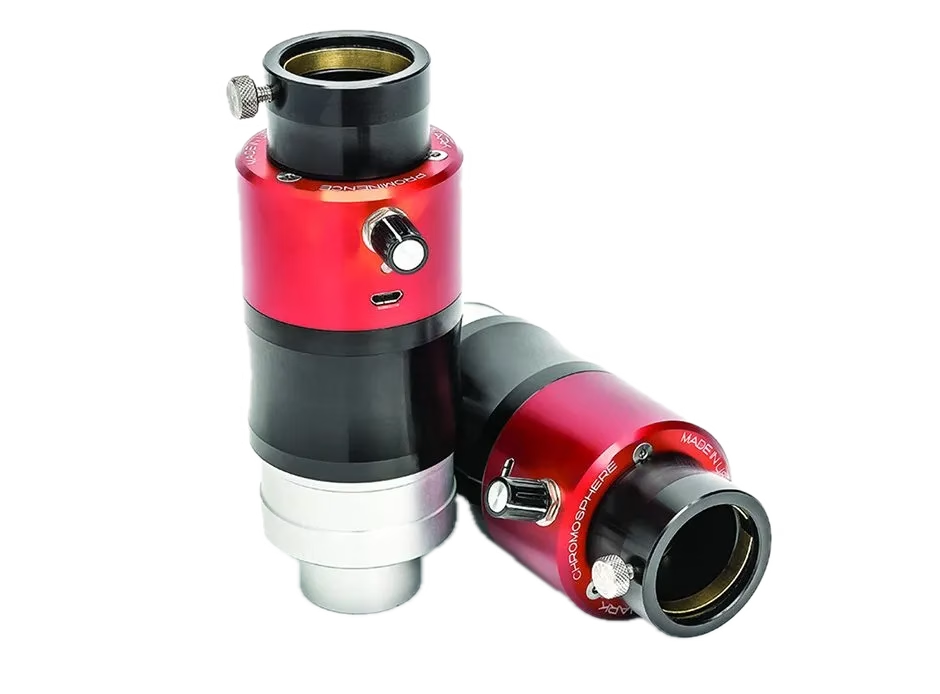
A choice of two versions, Prominence or Chromosphere, at the same price. The hardest part will be choosing.
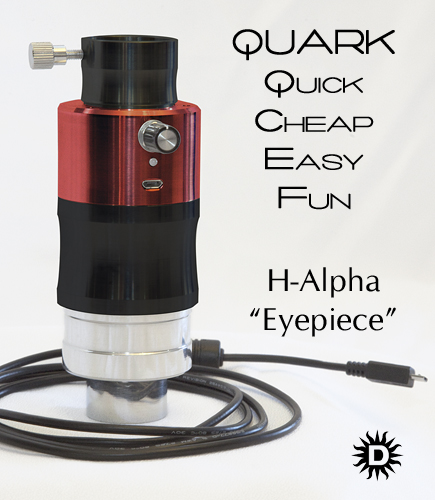
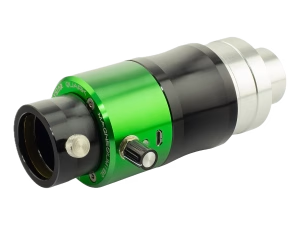
In concrete terms, you don't touch your telescope. You remove your eyepiece, insert the QUARK, put the eyepiece back on, and observe. It's as simple as that.
QUARK performs at its best on refractors between f/4 and f/8. It works outside this range, but with some compromises on brightness or bandwidth finesse (details below).
| Type | H-alpha all-in-one eyepiece format filter |
|---|---|
| Available versions | Prominence (wider band, brighter image) or Chromosphere (narrower band, better surface contrast) |
| Integrated optics | 4.2× telecentric barlow, 2 elements, optimized for 656 nm |
| Free opening | 21 mm |
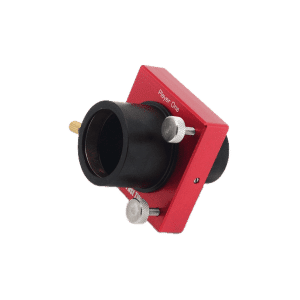
| Interface | 1.25″ eyepiece output, 1.25″ and 2″ adapters supplied |
| Power supply | USB 5 V (1.5 A recommended), 90-240 VAC power adapter and international plugs supplied |
| Setting | Tuning wheel ±0.5 Å with 0.1 Å steps, status LED |
| Accessories included | Brass clamping ring, Twist-Case, adapters |
| Warranty | 5 years |
| Autonomy | Low power consumption, compatible with optional battery pack (up to 8h) |
| The ideal beach | f/4 to f/8 refractors, full-disc up to approx. 450 mm focal length |

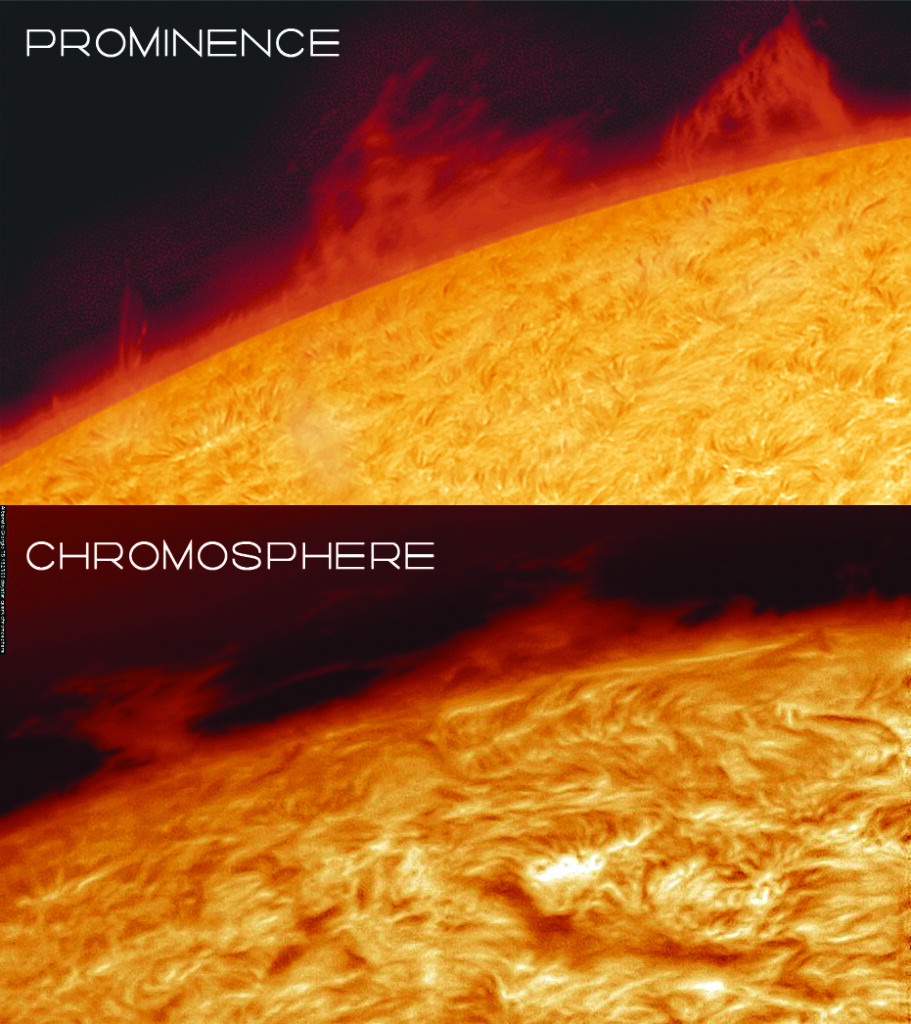
This is the question I'm asked most often. The answer can be summed up in one sentence: both show the surface and the protuberances, but with a different bandwidth, and therefore a different compromise between brightness and contrast.
| Criteria | Chromosphere | Prominence |
|---|---|---|
| Bandwidth (FWHM) | Narrower, higher spectral selectivity | Wider, more light |
| Filaments and surface details | Clearly visible, that's its strong point | Less pronounced, sometimes invisible depending on conditions |
| Limb protuberances | Visible, sometimes with less contrast than in Prominence | Very bright and spectacular |
| Chromospheric contrast (patches, spots, granulation) | Excellent, ideal for detailing | Weaker, the emphasis is on brightness |
| Public type | Versatile observers, astrophotographers of the solar disk | Observers who mainly want spectacular protuberances |
| Visual sensation | Slightly darker image, rich in fine detail | Brighter image, eye-catching protuberances |
| Telescope type | What it looks like |
|---|---|
| Refractors f/4 to f/8 | Recommended configuration for optimum performance |
| Refractors beyond f/9 | Works, but darker visual image. More photo-oriented. |
| Refractors below f/4 | Works, brighter image but wider bandwidth |
| Large diameters | No aperture limit, QUARK accepts large instruments to increase magnification |
| Off-axis configurations | The QUARK is not designed for this purpose. |
Yes, without exception. The difference is that Prominence makes them brighter and more spectacular, while Chromosphere reveals the filaments and fine texture of the surface.
No. The QUARK is a stand-alone H-alpha unit, designed to stand alone in the optical chain. Stacking unsuitable front-end filters is at best inefficient, at worst dangerous. The only exception is ERFs (Energy Rejection Filters), which are designed to operate upstream.
Yes, as long as you follow the manufacturer's instructions. Never point the Sun without equipment specifically designed and certified for this purpose.
Take the Chromosphere if :
Take the Prominence if :
In practice, the majority of our customers choose the Chromosphere for its versatility. But if you already know that what makes you tick is the protuberances, the Prominence will not disappoint.