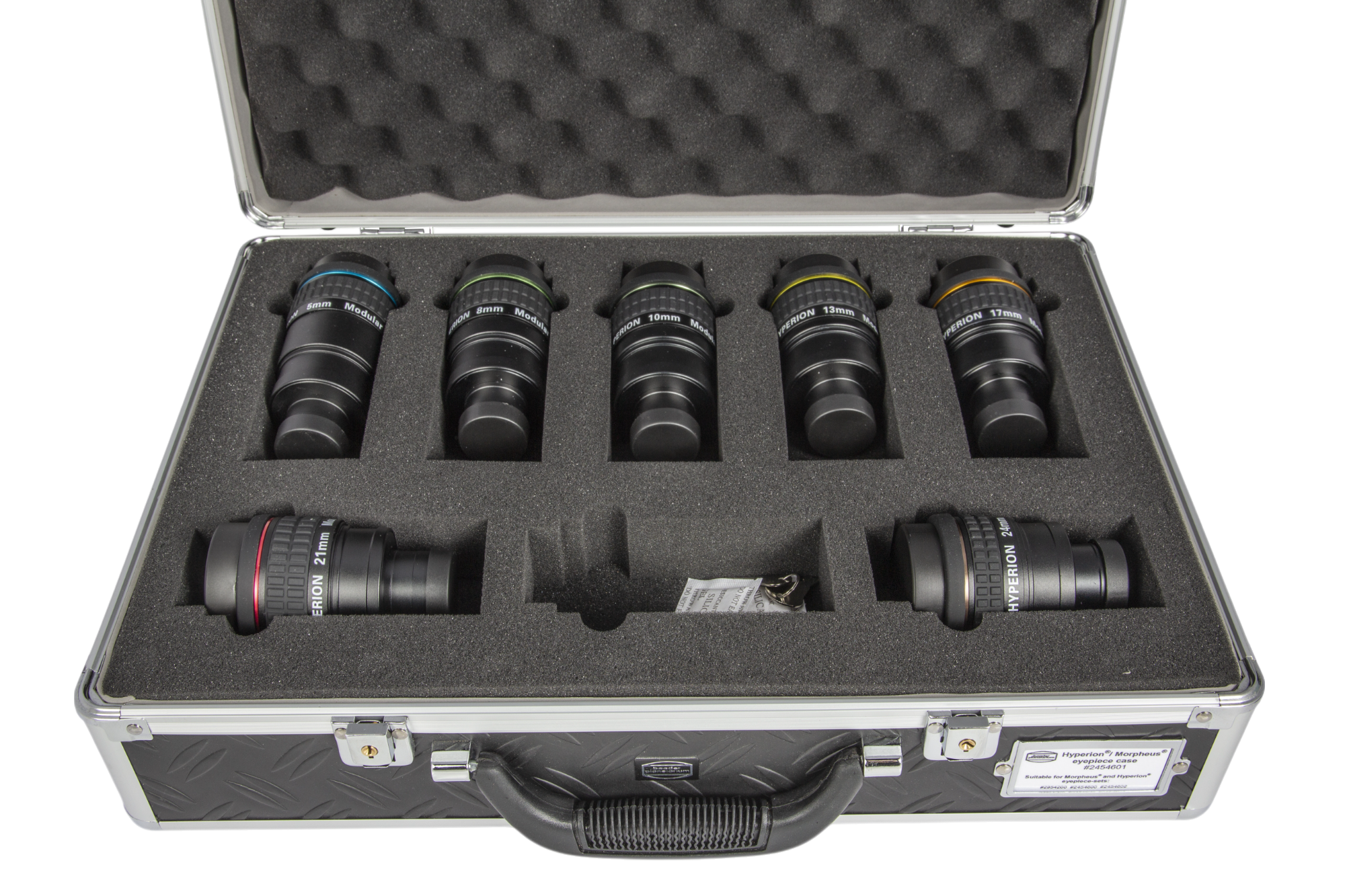
A telescope is two things: a mirror (or optical system) that collects light, and a set of eyepieces that transform this light into images. The tube does 80 % of the work; the eyepieces do the 20 % you actually see. You might as well choose them carefully.
This article is intended for owners (or future owners) of a 150 mm (6″) F/5 tabletop Dobsonian, a 200 mm (8″) Dobsonian at F/6, a 254 mm (10″) at F/4.7, a 300 mm (12″) at F/5, or a 400 mm (16″) at F/4, the most common configurations on the market today, as well as to owners of a Celestron C8 Schmidt-Cassegrain (200/2000, F/10), one of the world’s best-selling telescopes. The same logic applies to other F/D ratios, provided that the exit pupil is recalculated and the required optical quality is taken into account.
Contents
1. The logic behind a range of eyepieces
Before talking about precise focal lengths, it's important to understand what we want to cover. A complete range is organized around four roles, not an arbitrary sequence of focal lengths:
- Low-magnification (wide-field) eyepiece. Low magnification, wide apparent field, exit pupil close to maximum usable. For framing large objects (M31, M33, Cygnus lace, NGC 7000) and using nebular filters (UHC, OIII, H-beta). Not to be confused with the researcher, which is the pointing device attached to the tube: here we're talking about an eyepiece that fits into the main eyepiece holder.
- The general-purpose deep-sky eyepiece. Medium magnification, the best compromise between brightness and resolution for most galaxies, globular clusters and planetary nebulae. This is the eyepiece that will stay in the 60 % eyepiece holder the longest.
- The planetary/lunar eyepiece. High magnification, small exit pupil. Its exact focal length depends on the atmospheric turbulence of the moment, which varies from hour to hour. That's why a range of closely spaced focal lengths (rather than a single eyepiece) is a smart investment.
- The intermediate eyepiece. Optional. Useful for targets with low surface brightness (M101, M81 with spiral arms, M33) that require both a wide field of view and a little more magnification than the low-magnification eyepiece.
The trap to avoid, especially when starting a collection: stacking focal lengths too close together in the deep sky (where 2 or 3 magnifications are sufficient) and a single eyepiece in planetary (where you'd like to have five).
2. The two parameters that decide everything
2.1. Magnification
Formula : G = Ftube / Focular. For a Dobson 200/F6, Ftube = 1200 mm. A 12 mm eyepiece therefore gives 100×. For a C8 (Ftube = 2000 mm), the same 12 mm eyepiece gives 167×.
The maximum useful magnification is generally estimated at 2× diameter in mm, 400× for a 200 mm (Dobson or C8), 508× for a 254 mm and 600× for a 300 mm. In practice, the atmosphere is very often limited to 250-300×., even under very clean sites. This explains why a 300 mm lens doesn't necessarily provide more useful magnification than a 254 mm lens, but rather more light.
2.2. The exit pupil
Formula : P = Focular / N, where N is the F/D ratio of the tube. For an F/6, P = Focular / 6. For a C8 at F/10, P = Focular / 10. This is the diameter of the light beam that exits the eyepiece and enters your eye.
- P > 6-7 mm wasted light. The adult human pupil rarely dilates beyond 6 mm after the age of 40, and 7 mm in a young person under very dark skies. Excess light is lost on the iris.
- P ≈ 5-6 mm the large, rich field. Ideal for extended nebulae and OIII/UHC filters.
- P ≈ 2-3 mm the queen of the deep sky. Contrast is optimal for most galaxies.
- P ≈ 1 mm Comfortable planetary image. Bright image, sharp details when seeing follows.
- P < 0.7 mm High limit. The image becomes dull, and ocular defects (flying flies) become visible. Reserve for nights when the atmosphere permits.
It's this parameter, more than raw magnification, that dictates whether a focal length has a place in your range.
3. Focal length spacing: the trap of too-tight pairs
When building your range, there's one rule that's often overlooked: each eyepiece you add must provide a perceptible jump in magnification. Otherwise, you're paying for redundancy.
A good rule of thumb: aim for a focal length difference of approx. 1.4× to 1.7× between two consecutive eyepieces. Below, the difference is barely noticeable; above, you leave a hole you'll regret some nights.
In concrete terms, in the planetary range, it is necessary to choose between certain pairs rather than accumulating them:
- If you take an 8 mm, forget the 7 mm and go straight to a 6 mm (ratio 8/6 = 1.33×, already tight but noticeable).
- If you use a 9 mm, the next logical step is a 7 mm (1.29× ratio) then a 5 mm.
- Between 6 and 5 mm, The ratio is 1.2×, which is very tight. Combining the two only makes sense if you observe planets very often and if local seeing justifies it.
- Between 5 and 4 mm, At 1.25× ratio, same remark, but as we're already at very high magnification, the perceived image difference is a little sharper.
In deep sky conditions, it's the opposite: you can afford larger jumps (1.5× to 2× ratio) without losing anything. A 30mm + a 13mm covers the useful range, without the need for an intermediate 18mm.
This spacing rule explains why we recommend focus on depth in the planetary range (4-10 mm) rather than in the deep sky range (12-25 mm).
4. Do we need a barlow? A question of honest arithmetic
The barlow is astronomy's worst-selling accessory. On paper, it doubles your range: «buy a 2× barlow and every eyepiece becomes two eyepieces!» In practice, the economic calculation is more nuanced.
The numerical example
Suppose you build the following range for a 200/F6:
- 30 mm, 18 mm, 12 mm, 5 mm, 4 mm + 2× barlow.
In theory, the barlow gives you these additional focal lengths: 15 mm (since the 30), 9 mm (since the 18) and 6 mm (since the 12). In reality :
- The 15 mm is useless (the 12 mm already does the job).
- The 9 mm is useful.
- The 6 mm is useful.
Bottom line: you get 2 focal lengths for the price of one barlow. But a quality barlow (apochromatic, with a good lens) costs about the same as two mid-range eyepieces. So you've saved nothing. You've just added an element to handle in the dark, to put away after each use, and an extra lens in the optical path.
When a barlow really matters
Three cases where it is fully justified:
- Filling a gap in an existing eyepiece range. Some lines are too wide apart (e.g. a direct jump from 7 mm to 4 mm). A 2× barlow on the 7 mm gives a 3.5 mm, but more importantly allows the use of another eyepiece at 6 mm (from a 12 mm) and 5 mm that the range doesn't offer.
- With premium eyepiece (Tele Vue, Pentax XW) where each one costs several hundred francs. Here, doubling the range with a single barlow brings real savings.
- With dedicated zoom eyepiece (See Section 12.3 on the Hyperion Zoom + 2.25× Barlow lens), where the Barlow lens does more than just add focal lengths: it shifts the entire range toward the planetary range and provides a consistent tool for infinite focal lengths.
Apart from these cases: a fixed eyepiece at the right focal length always gives an image that's at least as good, without any additional handling, and rarely costs more in the end.
5. Coma: a poorly understood defect
Coma is the most characteristic optical aberration of parabolic mirror telescopes (Newton, Dobson). It deforms stars into small comets (hence the name), with the tip pointing towards the center of the field. It is present everywhere except at the exact center of the field, and its intensity increases with distance from the center.
5.1. Which depends on the F/D ratio
The intensity of the coma depends solely on the telescope F/D ratio, not the eyepiece:
- F/6 and longer (Dobson 200/F6): weak coma, perceptible only at the edge of the field with a wide-field eyepiece. Many observers do without it without any noticeable discomfort.
- F/5 (Dobson 300): coma clearly visible. A corrector provides a real gain.
- F/4.7 and faster (Dobson 254 type Sky-Watcher 250P, Dobson 400+): marked coma. A corrector is no longer optional; it's what transforms the visual experience.
- F/10 (Schmidt-Cassegrain C8): almost non-existent visual coma.
5.2. A misconception to correct: «Comas are only visible at low magnification».»
We often read that coma would only be troublesome with wide-field eyepieces at low magnification, and that it would «disappear» at high magnifications. This is not true. Here's why.
Coma is a defect linear its physical size on the telescope's focal plane is constant for a given distance from the center. When you increase the magnification (shorter focal length eyepiece), two things happen simultaneously :
- The true field decreases, so you see an area closer to the center where the coma is physically weaker.
- But this residual coma is even larger by the additional magnification.
The two effects cancel each other out exactly. The apparent size of a star's comatic tail at the edge of the field remains exactly the same, whatever eyepiece is used.
A coma corrector is useful whenever you look at the edge of the apparent field, regardless of the eyepiece focal length. Whether you're using 50× or 300× magnification, if coma was a problem at low magnification, it will be just as much of a problem at high magnification.
5.3. So why does it often seem to disappear?
Because at high magnification, other defects become more visible and mask the coma:
- Visit atmospheric turbulence (seeing) is already distorting stars well beyond coma.
- Visit other aberrations (edge astigmatism, field curvature) take over.
- Visit tube vibrations and collimation errors are also amplified.
The coma has not disappeared: it is simply drowned out by the visual noise. On a well-collimated mount, with excellent seeing and a quality eyepiece, the coma becomes perfectly perceptible again at high magnifications.
5.4. Practical implications for eyepiece selection
On a fast Dobson (F/5 or faster), two options:
- Invest in a coma corrector (Baader MPCC Mark III, Tele Vue Paracorr) and use medium-quality eyepieces. This is the most economical option in the long run. The corrector corrects coma over the entire field, for all eyepieces.
- Ignore on-board coma and concentrate on the 80 central %s in the field. This strategy works well for the planetarium and moon (central targets), but becomes frustrating in the deep sky where extended nebulae overflow.
Conversely, on a Schmidt-Cassegrain F/10 or a moderate Dobson F/6, the coma is low enough that the debate doesn't really arise. A decent eyepiece is all you need.
6. 150 mm F/5 Tabletop Dobsonian Telescope Series (750 mm focal length)
Minimum range: 25 + 10 + 6 mm. Ideal range: 25 + 15 + 10 + 6 + 4 mm.
Low budget, easy portability, short focal length = modest magnification. A coma corrector is useful but often disproportionate to the price of the tube; edge coma is generally accepted.
Most frequent case : Almost all consumer-grade 150-mm tabletop Dobsonians have an F/5 ratio (Sky-Watcher Heritage 150P FlexTube, Bresser Messier 6″). Focal length = 750 mm. These are «serious» entry-level instruments: portable, easy to use, and remarkably effective for their price, but with two specific limitations that change the way you choose eyepieces.
6.1. What's Different Compared to Larger Dobson Telescopes
- Very short focal length (750 mm) : For the same eyepiece focal length, the magnification is nearly half that of a 200/F6 and one-third that of a C8. A 10 mm eyepiece provides 75× magnification on a 150/F5, compared to 120× on a 200/F6. As a result, short focal lengths (4–6 mm) become truly useful, whereas on other Dobsonians they are already considered extreme.
- F/5 short : Coma is present and visible with a wide-field eyepiece. However, since the telescope often costs less than a high-end coma corrector (Paracorr), most users accept the coma at the edges and focus on the central 70 % of the field. This is a reasonable compromise for this type of instrument.
- Limited diameter : Maximum useful magnification ≈ 200×. There is no need to go below 4 mm.
- Output terminal = Foc / 5 : maximum 30 mm (P=6 mm). A 32- or 40-mm aperture would result in a pupil that is too large.
6.2. Table of Useful Focal Lengths
| Focal length | Magnification | Output pupil | Role |
|---|---|---|---|
| 25–28 mm (2″ or 1.25″) | ≈ 27–30× | 5.0–5.6 mm | Low magnification. Ceiling at 30 mm : beyond that, the pupil is too wide. |
| 15–18 mm | ≈ 42–50× | 3.0–3.6 mm | Intermediate / open clusters / wide-field |
| 10–12 mm | ≈ 62–75× | 2.0–2.4 mm | Deep sky generalist, priority |
| 6–8 mm | ≈ 94–125× | 1.2–1.6 mm | Planetary / lunar, priority |
| 4–5 mm | ≈ 150–188× | 0.8–1.0 mm | High-magnitude planetary body, upper operational limit |
On a 150 mm table, three eyepieces are more than enough: 25 mm + 10 mm + 6 mm cover 90 % of situations. The telescope is designed for portability: keeping the eyepieces lightweight is consistent with the overall design concept.
6.3. Eyepiece Recommendations
The 150 mm tabletop telescope is, above all, a portable, entry-level instrument. Spending 1,500 CHF on eyepieces for a 400 CHF tube doesn't make sense. Stick to third-party entry-level and mid-range products (see Section 13) :
- First Purchase (Very Small Budget) : the Sky-Watcher Super Plössl eyepieces (25 mm + 10 mm + 6 mm), about 30–60 CHF each. Acceptable in the center, with noticeable coma at the edges, but consistent with the overall budget.
- Smart Shopping (Medium Budget) : Explore Scientific 68° or Sky-Watcher Nirvana 82° for wide-field viewing + a Hyperion or a Celestron X-CEL LX for planetary observation. You’ll enjoy greater comfort and better image quality for 150–250 CHF per eyepiece.
- Versatile zoom the Baader Hyperion Zoom Mark IV (8–24 mm) It covers almost the entire useful range (31× to 94×) on its own. It’s an excellent choice for this type of instrument, where simplicity is key. There’s no need for a Barlow lens here: the maximum magnification without a Barlow lens already covers the useful planetary range.
Minimum recommended range : 25 mm + 10 mm + 6 mm.
Ideal range : 25 mm + 15 mm + 10 mm + 6 mm + 4 mm. Or, to put it more simply: 25 mm + Hyperion Mark IV zoom.
7. Series for 200 mm F/6 Dobsonian (1200 mm focal length)
Minimum range: 30 + 12 + 8 mm. Ideal range: 30 + 17 + 12 + 8 + 5 mm.
F/6 is soft: no coma corrector is needed; the Hyperions are more than enough.
| Focal length | Magnification | Output pupil | Role |
|---|---|---|---|
| 30-32 mm (2″) | ≈ 38-40× | 5.0-5.3 mm | Low magnification, wide fields, nebular filters |
| 17-18 mm | ≈ 67-70× | 2.8-3.0 mm | Intermediate (optional) |
| 12-13 mm | ≈ 92-100× | 2.0-2.2 mm | Deep sky generalist, priority |
| 8-9 mm | ≈ 133-150× | 1.3-1.5 mm | Planetary conservative, priority |
| 6 mm (if 8 mm taken) or 7 mm (if 9 mm taken) | ≈ 170-200× | 0.86-1.0 mm | Planetary medium seeing |
| 5 mm | ≈ 240× | 0.83 mm | Planetary bon seeing |
| 4 mm | ≈ 300× | 0.67 mm | Planetary excellent seeing |
If you choose an 8 mm as your conservative planetary gear, go with a 6 mm next (and not a 7 mm, which is too close). If you start with a 9 mm, then a 7 mm makes sense. The 5 mm works in both cases.
Minimum recommended range : 30 mm + 12 mm + 8 mm. Three eyepieces cover 90 % situations.
Ideal range : 30 mm + 17 mm + 12 mm + 8 mm + 5 mm.
8. Lineup for the 254 mm F/4.7 Dobsonian (1200 mm focal length)
Minimum range: 31 + 12 + 8 mm + coma corrector. Ideal range: 31 + 21 + 12 + 8 + 5 mm + corrector.
So the focal length is the same as the 200/F6 the same magnifications, but 60 % more light and more noticeable coma: a corrector is recommended.
Most frequent case : consumer Dobson 254 mm are F/4.7 (Sky-Watcher Skyliner 250P, Flextube 250P). Focal length = 1200 mm, identical to the Dobson 200 mm F/6. The difference lies elsewhere.
Theoretical maximum magnification : 508×. In practice : 280-350× on a good night.
The change from 200 mm F/6 to 254 mm F/4.7 changes two things:
- Collecting diameter 60 % more light faint objects become accessible, and the details of galaxies and nebulae become sharper.
- Shorter F/D ratio (F/4.7) amplifies eye defects (coma, field curvature, astigmatism) and increases the exit pupil for the same eyepiece focal length (P = Focular / 4,7). A coma corrector (Paracorr, MPCC) is essential for all eyepiece focal lengths, not only in the wide field (see section 5), and avoid excessively long focal lengths, which would result in excessive pupil size.
| Focal length | Magnification | Output pupil | Role |
|---|---|---|---|
| 30-31 mm (2″) | ≈ 39-40× | 6.4-6.6 mm | Low magnification. 36 mm pitch 7.7 mm pupil = too wide. |
| 20-21 mm | ≈ 57-60× | 4.2-4.5 mm | Intermediate / extended nebulae |
| 12-13 mm | ≈ 92-100× | 2.6-2.8 mm | Deep sky generalist, priority |
| 8-9 mm | ≈ 133-150× | 1.7-1.9 mm | Planetary conservative, priority |
| 6 mm (if 8 mm taken) or 7 mm (if 9 mm taken) | ≈ 170-200× | 1.3-1.5 mm | Planetary medium seeing |
| 5 mm | 240× | 1.06 mm | Planetary bon seeing |
| 4-4.5 mm | ≈ 267-300× | 0.85-0.96 mm | Planetary excellent seeing |
The same logic applies as with the 200 mm. An 8 mm pairs well with a 6 mm, followed by a 4.5 mm. A 9 mm pairs well with a 6.5 mm, followed by a 4.5 mm. Avoid combining focal lengths that are too close together.
Minimum recommended range : 31 mm + 12 mm + 8 mm + coma corrector.
Ideal range : 31 mm + 21 mm + 12 mm + 8 mm + 5 mm + coma corrector.
9. Series for 300 mm F/5 (1500 mm) or F/6 (1800 mm) Dobsonian
Minimum range: 31 + 13 + 9 mm + coma corrector. Ideal range: 31 + 21 + 13 + 9 + 5 mm + corrector.
F/5 = 36 mm pitch (pupil too wide); Morpheus recommended; coma corrector required.
Most frequent case : Dobson 300 mm consumer models are in F/5 (Sky-Watcher Flextube 300P, Skyliner 300P). Focal length = 1500 mm. F/6 models (1800 mm) exist, but are rarer and bulkier. The values below are calculated for the F/5.
Theoretical maximum magnification : 600×. In practice : 300-400× on very good nights.
At F/5, two new constraints appear:
- The exit pupils are for the same focal length eyepiece (P = F/5). A 30 mm gives a 6 mm pupil, already at the high limit.
- Eye defects (coma, field curvature, astigmatism) are seen much more at F/6. An average eyepiece at F/6 can become mediocre at F/5. Investing in quality eyepieces is a real return on investment here, and a coma corrector (Paracorr, MPCC) is a must. useful for all eyepiece focal lengths, not only in the wide field (see section 5).
| Focal length | Magnification | Output pupil | Role |
|---|---|---|---|
| 30-31 mm (2″) | ≈ 48-50× | 6.0-6.2 mm | Low magnification. 36 mm pitch pupil too large. |
| 20-21 mm | ≈ 71-75× | 4.0-4.2 mm | Intermediate / extended nebulae |
| 13-14 mm | ≈ 107-115× | 2.6-2.8 mm | Deep sky generalist, priority |
| 9-10 mm | ≈ 150-167× | 1.8-2.0 mm | Planetary conservative, priority |
| 7 mm (if 10 mm taken) or 6.5 mm (if 9 mm taken) | ≈ 214-230× | 1.3-1.4 mm | Planetary medium seeing |
| 5 mm | ≈ 300× | 1.0 mm | Planetary bon seeing |
| 4-4.5 mm | ≈ 333-375× | 0.8-0.9 mm | Planetary excellent seeing |
Same as the two previous diameters. The 300 mm model allows for higher effective magnification, so the 4.5 mm lens really comes into its own here, whereas it was of limited use on the 200 mm model.
Minimum recommended range : 31 mm + 13 mm + 9 mm + coma corrector.
Ideal range : 31 mm + 21 mm + 13 mm + 9 mm + 5 mm + coma corrector.
10. Series for the 400 mm F/4 Dobsonian (1600 mm focal length)
Minimum range: 22–24 + 13 + 9 + 5 mm + coma corrector. Ideal range: 22–24 + 16 + 12 + 9 + 6.5 + 4 mm + corrector.
F/4 is demanding: Avoid Hyperion; Morpheus is the minimum requirement; Tele Vue is ideal. A coma corrector is required.
Consumer 400 mm Dobson (Sky-Watcher Stargate 400P, GSO 16″) are almost all in F/4, focal length 1600 mm. This is the diameter where faint objects change nature: Hickson galaxies, planetary nebula structure, globular cluster resolution right down to the core. But it's also the instrument where modest eyepieces become frankly unusable.
Theoretical maximum magnification : 800×. In practice : 350-450× on very good nights. Beyond that, it's the seeing that decides, not the diameter.
The switch from 300/F5 to 400/F4 changes three major things:
- Collecting diameter 78 % more light. You can see targets inaccessible to a 300mm camera, such as M87 jets or distant galaxy clusters.
- The F/4 ratio strongly amplifies eyepiece defects. Coma is more pronounced (see section 5), and even mid-range eyepieces show visible edge astigmatism. A coma corrector is no longer optional, it's a prerequisite. And eyepieces must be designed for F/4 (Nagler, Ethos, Delos, Morpheus, Pentax XW), not the classic Plössl or Hyperion.
- The exit pupil quickly reaches extremes (P = Focular / 4). A 28 mm already gives 7 mm, an absolute ceiling. A 4 mm gives 1 mm, already austere on diffuse targets (see practical experience with M13 below).
| Focal length | Magnification | Output pupil | Role |
|---|---|---|---|
| 22-26 mm (2″) | ≈ 62-73× | 5.5-6.5 mm | Low magnification. 26 mm ceiling Beyond, pupil > 6.5 mm. |
| 16-17 mm | ≈ 94-100× | 4.0-4.25 mm | Intermediate / large globular clusters / extended nebulae |
| 12-13 mm | ≈ 123-133× | 3.0-3.25 mm | Deep sky generalist, priority |
| 9 mm | 178× | 2.25 mm | Medium-sized galaxies, resolution globular clusters, priority |
| 6.5 mm | 246× | 1.63 mm | Planetary / fine resolution of globular clusters |
| 5 mm | 320× | 1.25 mm | Planetary good seeing / small planetary nebulae |
| 4 mm | 400× | 1.0 mm | Planetary excellent seeing / high resolution |
| 3.5 mm | 457× | 0.87 mm | Upper limit usable, exceptional nights only |
On a 400 mm telescope, two planetary stages (9 mm + 6.5 mm, or 9 mm + 5 mm) are almost essential. The direct jump from 9 mm to 4 mm (2.25× magnification) is too large and leaves a gap exactly in the range where seeing varies the most.
10.1. Practical Example Using M13
To understand the effect of the exit pupil on a 400 mm f/4 lens:
- With a 16 mm Nagler (100×, P=4 mm): M13 appears bright, high-contrast and beautiful overall, but the central «paste» remains partially unresolved.
- With a Radian 4 mm (400×, P=1 mm): the image darkens considerably. The background becomes almost black, but the cluster resolves itself into a myriad of individual stars.
Why? The brightness of a large area (sky background, unresolved background) varies as the square of the exit pupil. By going from 4 mm to 1 mm, you reduce that brightness by a factor of 16. Conversely, point-like stars lose virtually no brightness. The result: the contrast between the stars and the background skyrockets, and the cluster becomes resolved.
These two views are complementary: 16 mm for the overall view, 9 or 6.5 mm for the ideal compromise, and 4 mm for detailed analysis of the heart.
10.2. Product Line Recommendations
Minimum recommended range : 22 or 24 mm (2″) + 13 mm + 9 mm + 5 mm + coma corrector.
Ideal range : 22 or 24 mm (2″) + 16 mm + 12 mm + 9 mm + 6.5 mm + 4 mm + coma corrector.
Regarding models: at F/4, classic Hyperions show their limits at the edge of the field. Favoring Morpheus (excellent up to F/4, unbeatable quality/price ratio in this category). Tele Vue Nagler/Delos/Ethos (absolute reference, consequent price), or the Pentax XW (exceptional comfort, 70° field of view). In wide 2″ field, an Explore Scientific 24 mm 82° or a Nagler 22 mm are the most coherent choices.
11. Lineup for Schmidt-Cassegrain C8 (200/2000, F/10)
Minimum range: 32 (2″) + 17 + 10 mm. Ideal range: 32 (2″) + 24 + 17 + 12 + 8 + 5 mm.
F/10 forgives everything: Plössl eyepieces are sufficient in the center; Hyperion eyepieces are ideal. No coma corrector is necessary. The 0.63× reducer is a photography accessory, not an eyepiece.
The Celestron C8, and more broadly all Schmidt-Cassegrain 200 mm to F/10 models, share the same diameter as a Dobson 200 mm, but a very different focal length: 2000 mm vs. 1200 mm. This long focal length radically changes the logic of the eyepiece range.
11.1. How It Differs from an F/6 Dobsonian
- For the same eyepiece focal length, magnification is 1.67× higher. A 12 mm gives 167× on a C8 (compared with 100× on a Dobson 200/F6). This is comfortable for the planetary, but limiting for the wide field.
- The exit pupil is smaller for the same eyepiece focal length (P = F/10). A 30 mm lens gives a pupil of just 3 mm, not at all a large, rich field. To achieve a 5-6 mm pupil, you need a 50-60 mm lens, a rare and expensive focal length.
- Coma and field curvature are virtually non-existent visually. No need to invest in a coma corrector. More modest eyepieces (quality Plössl, classic Hyperion) suffice where a Dobson F/5 would require top-of-the-range.
- The true field is physically limited by the tube's internal baffle and by the diameter of the eyepiece holder. With a 2″ cast, the maximum usable field on a C8 is around 1.2°; beyond that, you get vignetting. In concrete terms, a 40 mm 2″ very wide field will not give not a significantly wider field of view than a 32 mm 2″ Plössl format, because the tube doesn't let enough beam through.
- The 0.63× focal reducer is a photo accessory., not visual; see Section 11.3 for details.
11.2. Table of Useful Focal Lengths (C8 at f/10, 2000 mm focal length)
Theoretical maximum magnification : 400×. In practice : 250-300× on a good night.
| Focal length | Magnification | Output pupil | Role |
|---|---|---|---|
| 40 mm (2″), Plössl or standard format | 50× | 4.0 mm | Low maximum usable magnification. 50 mm pitch 2″ : limited by the baffle. |
| 32 mm (2″), 70° Plössl | 62× | 3.2 mm | Alternative to 40 mm, wider apparent field, often optimal choice |
| 24 mm (2″ or 1.25″) | 83× | 2.4 mm | Intermediate / extended nebulae |
| 17-18 mm | ≈ 111-117× | 1.7-1.8 mm | Deep sky generalist, priority |
| 12-13 mm | ≈ 154-167× | 1.2-1.3 mm | Planetary conservative, priority |
| 9-10 mm | ≈ 200-222× | 0.9-1.0 mm | Planetary medium seeing |
| 7 mm (if 10 mm taken) or 6.5 mm (if 9 mm taken) | ≈ 286-308× | 0.65-0.7 mm | Planetary bon seeing |
| 5 mm | 400× | 0.5 mm | Planetary excellent seeing, high limit |
On a C8, you don't need to go below 5 mm. At 400×, the exit pupil is already at 0.5 mm, so you're at the upper limit of usability. A 4 mm would give 500×, which exceeds the useful magnification of the diameter and would only result in a darker, shakier image.
The logic is the same as for Dobsonians. On a C8, the 13 mm + 9 mm combination works very well (1.44× magnification ratio), as does 12 mm + 8 mm. Avoid using 12 mm and 13 mm together, or 9 mm and 10 mm.
11.3. What about the 0.63 focal length reducer? Not for this lens.
We often read that the Celestron f/6.3 gearbox «opens up the C8 to a wide field of vision». It's true a misleading shortcut. Let's be precise:
- The reducer reduces the focal length of the telescope (2000 mm → 1260 mm). As a result, for a given eyepiece, the magnification decreases and the true field increases.
- But visually, you would obtain exactly the same result using a longer focal length eyepiece, without adding an extra lens in the optical path. The reducer offers no optical gain of its own in visual terms; it simply shifts your focal range.
- The F/D ratio, on the other hand, is of no importance than in astrophotography, where it determines the exposure time required. In visual terms, it has only a marginal influence on sensitivity to eyepiece defects (coma, field curvature), a subject of no real consequence on a C8 whose optical quality forgives anything.
The f/6.3 reducer is a photo accessory. For visual purposes, it's of no interest; to gain field, choose a longer focal length eyepiece instead (32 or 40 mm in 2″), which is simpler and optically cleaner.
11.4. Product Line Recommendations
Minimum recommended range : 32 mm (2″) + 17 mm + 10 mm. Three eyepieces, you cover 90 % situations.
Ideal range : 32 mm (2″) + 24 mm + 17 mm + 12 mm + 8 mm + 5 mm.
12. Specifically, which eyepieces?
Three recommendations according to budget and use: the range Hyperion (value for money), the Morpheus (comfortable high-end), and the Hyperion Mark IV zoom with barlow (compact planetary solution). All these ranges have been tested in real-life conditions: we only list what we use.
12.1. Baader Hyperion: The Gold Standard for Value for Money
Apparent field of 68° (72° in 2″), eye relief of ≈ 20 mm, optical quality very decent down to F/6 and acceptable at F/5 in the center. On a Schmidt-Cassegrain F/10, they give their best as the long F/D ratio forgives all. Modularity 1.25″/2″ and T2 compatibility make this one of the most versatile eyepieces on the market.
Available focal lengths : 36, 31, 24, 21, 17, 13, 10, 8 and 5 mm.
Recommended selection by instrument :
| Instrument | Large field | Intermediate | Deep sky | Planetary | High mag. |
|---|---|---|---|---|---|
| Dobson 150/F5 (table) | 25 mm | 17 mm | 10 mm | 8 mm | 5 mm |
| Dobson 200/F6 | 31 mm | 17 mm | 13 mm | 8 mm | 5 mm |
| Dobson 254/F4.7 | 31 mm (step 36) | 17 mm | 13 mm | 8 mm | 5 mm + coma corrector |
| Dobson 300/F5 | 31 mm (step 36) | 21 mm | 13 mm | 10 mm | 5 mm + coma corrector |
| Dobson 400/F4 | Hyperions are not recommended at F/4 (poor field edge). See Morpheus below. | ||||
| Schmidt-Cassegrain C8 | 36 mm | 24 mm | 17 mm | 13 mm | 8 mm then 5 mm |
Please note: the Hyperion range doesn't offer fixed 6 or 7 mm, which creates a gap between planetary and high magnification. This is one of the cases where the Mark IV + barlow zoom or a 6.5 mm Morpheus can usefully complete the range.
12.2. Baader Morpheus: The Comfortable Top-of-the-Line Model
76° apparent field, 20 mm eye relief, Phantom Group™ coatings, perfect hold up to F/4. Particularly appreciated by spectacle wearers thanks to their adjustable eyecups and long relief. Optically, they rival references twice their price. Notable advantage: the 6.5 and 4.5 mm fill the gaps left by the Hyperions.
Available focal lengths : 17.5 / 14 / 12.5 / 9 / 6.5 / 4.5 mm.
Recommended selection by instrument (to be completed with a 2″ wide-field Hyperion 31 or 36 mm type, as the Morpheus range does not have a 2″ long focal length) :
| Instrument | Intermediate | Deep sky | Planetary | Medium seeing | High mag. |
|---|---|---|---|---|---|
| Dobson 150/F5 (table) | A disproportionate investment compared to the tube. Recommended only if you plan to upgrade to a larger telescope. Otherwise, stick with Hyperion or Plössl. | ||||
| Dobson 200/F6 | 17.5 mm | 12.5 mm | 9 mm | 6.5 mm | 4.5 mm |
| Dobson 254/F4.7 | 17.5 mm | 12.5 mm | 9 mm | 6.5 mm | 4.5 mm |
| Dobson 300/F5 | 17.5 mm | 12.5 mm | 9 mm | 6.5 mm | 4.5 mm |
| Dobson 400/F4 | 17.5 mm | 14 mm | 9 mm | 6.5 mm | 4.5 mm + coma corrector |
| Schmidt-Cassegrain C8 | 17.5 mm | 12.5 mm | 9 mm | 6.5 mm | 4.5 mm (seeing excellent only) |
On Dobson 300/F5 and 400/F4, the Morpheus holds its ground where the Hyperion becomes unusable at the edges. This is the reference option for these fast instruments. On C8, the 4.5 mm gives 444× (P=0.45 mm): to be reserved for perfect nights.
12.3. Baader Hyperion Universal Zoom Mark IV + 2.25× Barlow lens, the planetary/solar combo
Let's be honest about this zoom. Used alone at 8-24 mm, the Hyperion Mark IV is not our favorite eyepiece for deep-sky night observation. The apparent field of view drops from 68° at 24 mm (correct) to just 50° at 8 mm (narrow), giving a slightly «tunneling» sensation as you magnify. For visual deep sky observation, fixed wide-field eyepieces (Hyperion or Morpheus) remain superior in terms of comfort and immersion.
Two contexts, however, make it very interesting:
- Solar observation (AstroSolar Photo filter or H-alpha solar telescope): small, punctual target, useless wide field, and fine adjustment of magnification according to diurnal turbulence. This is where zoom alone comes into its own.
- Combined with Hyperion 2.25× barlow permanently screwed on, it becomes a 3.6 to 10.7 mm at infinite focal lengths, This is exactly the critical range for planetary and lunar night vision. This is one of the rare cases where a barlow brings real added value: it shifts the entire range towards the planetary and creates a coherent tool with continuous focal lengths.
Magnifications obtained by instrument :
| Instrument | Zoom only (8-24 mm) | Zoom + barlow 2.25× (3.6-10.7 mm) |
|---|---|---|
| Dobson 150/F5 (750 mm) | 31× → 94× | 70× → 208× |
| Dobson 200/F6 (1200 mm) | 50× → 150× | 112× → 333× |
| Dobson 254/F4.7 (1200 mm) | 50× → 150× | 112× → 333× |
| Dobson 300/F5 (1500 mm) | 62× → 187× | 140× → 417× |
| Dobson 400/F4 (1600 mm) | 67× → 200× | 150× → 444× |
| Schmidt-Cassegrain C8 (2000 mm) | 83× → 250× | 187× → 555× |
Recommendation by instrument :
- Dobson 150 Table Model: The zoom lens alone (without a Barlow lens) is an excellent option. It covers a range from 31× to 94×, which is the entire useful range for this aperture. Adding a Barlow lens allows for high-magnification planetary observations but becomes expensive for this type of instrument.
- Dobson 200 mm and larger: always buy zoom + barlow ensemble. Think of them as a single product dedicated to planetary/lunar.
- C8 : the zoom alone may suffice (it already covers 83× → 250×, i.e. the entire useful planetary range). The barlow becomes optional; with it, we even exceed the useful magnification of the diameter.
- All solar-powered instruments : the zoom alone is perfect.
13. Comparison by price range: entry-level, mid-range, high-end
The previous chapter showed you Which eyepiece? we recommend for each instrument. This section answers the follow-up question: Which eyepiece should you choose based on your budget?, across all brands. We carry Baader, Explore Scientific, Sky-Watcher, and Celestron: our goal is to help you find the right balance, not to push the brand that brings in the most profit.
The price ranges listed are current as of the date of publication. They may vary depending on exchange rates and promotions; please check our product pages for today's prices.
13.1. Entry-level tier (60–150 CHF)
These eyepieces work well on slow telescopes (F/8 and slower, achromatic refractors, Maksutovs) and on F/6 Dobsonians that do not require high field-of-view performance. Avoid using them on fast Dobsonians (F/5 and faster) where they produce distorted stars starting one-third of the way across the field.
| Model | Apparent field | Eye Relief | Available focal lengths | Price guide | Who is this for? |
|---|---|---|---|---|---|
| Sky-Watcher Super Plössl | 52° | short (2–15 mm) | 4, 6.3, 10, 12.5, 15, 17, 20, 25, 32 mm | 30–60 CHF | First supplementary eyepiece, tight budget, F/8+ scope |
| Sky-Watcher Long Eye Relief | 55° | 20 mm | 5, 8, 15, 20 mm | 50–80 CHF | Glasses Wearers on a Budget |
| Celestron Omni Plössl | 50° | short | 4, 6, 9, 12, 15, 20, 32, 40 mm | 40–70 CHF | An alternative to the Sky-Watcher Plössl, with comparable quality |
| Celestron E-Lux Kellner | 52° | variable | 26, 32, 40 mm (2″) | 80–120 CHF | Economical 2″ wide-field eyepiece for Schmidt-Cassegrain telescopes |
Things to avoid in this tier: very low-end models (eyepieces included with entry-level telescopes, generic Chinese kits priced under 30 CHF). The difference is immediately apparent, even to a beginner.
13.2. Mid-range tier (150–350 CHF)
The market's true sweet spot. Apparent field of view 65–82°, comfortable eye relief, decent optical quality up to F/5. This is where 80 % of sustainable purchases are made.
| Model | Apparent field | Eye Relief | Available focal lengths | Price guide | Who is this for? |
|---|---|---|---|---|---|
| Celestron X-CEL LX | 60° | 16 mm | 2, 3, 5, 7, 9, 12, 18, 25 mm | 120–160 CHF | A good planetary telescope at a reasonable price, F/6+ |
| Sky-Watcher Nirvana 82° | 82° | 10–15 mm | 4, 7, 16, 28 mm | 150–250 CHF | Wide field of view at an affordable price, up to f/5 |
| Explore Scientific 68° | 68° | 14–20 mm | 16, 20, 24, 28, 34, 40 mm (and 1.25″ shorter) | 180–280 CHF | Excellent for large fields, nitrogen-sealed |
| Explore Scientific 82° | 82° | 13–18 mm | 4.7 / 6.7 / 8.8 / 11 / 14 / 18 / 24 / 30 mm | 200–400 CHF | An alternative to Nagler lenses at half the price, up to f/4 |
| Baader Hyperion | 68° (72° in 2″) | 20 mm | 5, 8, 10, 13, 17, 21, 24, 31, 36 mm | 180–250 CHF (350 for the 2″ Aspheric) | Versatility and modularity; ideal at f/6, acceptable at f/5 |
| Celestron Luminos 82° | 82° | 15–20 mm | 7, 10, 15, 19, 23, 31 mm | 200–350 CHF | A direct competitor to the ES 82°, with a different finish |
Our recommendation in this tier: visit Hyperion for their versatility (1.25″/2″ dual-wall, T2 modular), the ES 82° for wide-field photography at F/5 or faster, and the Nirvana 82° for the best value in wide-angle lenses.
13.3. High-end tier (350 CHF and up)
Maximum comfort, impeccable optical quality up to f/4, state-of-the-art multi-layer coatings, and high-end mechanical finish. A worthwhile investment for fast instruments (F/4–F/5) or for long sessions where comfort comes first.
| Model | Apparent field | Eye Relief | Available focal lengths | Price guide | Who is this for? |
|---|---|---|---|---|---|
| Baader Morpheus 76° | 76° | 16–21 mm | 4.5, 6.5, 9, 12.5, 14, 17.5 mm | 270–300 CHF | The best value in the high-end segment, up to f/4 |
| Explore Scientific 100° | 100° | 15–18 mm | 5.5, 9, 14, 20, 25 mm | 500–900 CHF | A feeling of total immersion—an alternative to the Ethos |
| Explore Scientific 92° | 92° | 18–21 mm | 12, 17 mm | 500–700 CHF | Ultra-wide-angle and long eye relief compromise |
Our recommendation in this tier: visit Morpheus in 90 % of cases. They match or surpass eyepieces that are twice as expensive in terms of comfort and optical quality. The ES 100° and 92° models are only worthwhile if you are specifically looking for an immersive apparent field of view (large-aperture Dobson, dark skies).
13.4. A Category of Their Own: Zoom Lenses
Zoom eyepieces cannot be directly compared to fixed eyepieces. Their value lies elsewhere (see Section 12.3) : planet with variable seeing, solar observation, light travel.
| Model | Focal lengths | Apparent field | Eye Relief | Price guide | Who is this for? |
|---|---|---|---|---|---|
| Sky-Watcher Zoom | 7–21 mm | 40–60° | 15 mm | 80–120 CHF | Introductory zoom lens, tight budget, F/8+ aperture |
| Celestron Zoom | 8-24 mm | 40–60° | 15 mm | 100–150 CHF | Generic alternative, comparable quality |
| Explore Scientific Zoom | 7.2–21.5 mm | 50–65° | 18 mm | 250–350 CHF | A versatile, mid-range zoom lens |
| Baader Hyperion Zoom Mark IV | 8-24 mm | 50–68° | 16–19 mm | 300–400 CHF | Zoom reference, to be used with the 2.25× Barlow lens |
| Barlow Hyperion 2.25× (for use with) | ×2.25 on any eyepiece | - | - | 140–180 CHF | Essential for turning the Zoom Mark IV into a world-class tool |
13.5. Cross-reading: Which tier for which instrument?
A summary table to help you match your budget to your telescope:
| Instrument | Is this input acceptable? | Recommended setting | Justified top, right? |
|---|---|---|---|
| Dobson 150/F5 (table) | Yes (Plössl SW, Celestron Omni) | Hyperion or ES 68° if a change is expected | Unjustified vs. Tube Price |
| Dobson 200/F6 | Yes (Plössl SW, Celestron Omni) | Hyperion, ES 68° | Long sessions / person wearing glasses / dark skies |
| Dobson 254/F4.7 | No (unusable field edge) | ES 82°, Hyperion (center only) | Morpheus Highly Recommended |
| Dobson 300/F5 | No | ES 82°, Hyperion (compromise) | Morpheus or Ethos are practically mandatory |
| Dobson 400/F4 | Definitely not | At least 82° ES | Morpheus, ES 100°, Nagler/Ethos required |
| Schmidt-Cassegrain C8 | Yes (Plössl, Omni) | Hyperion, X-CEL LX | Comfort only, marginal visual improvement |
The faster your telescope (shorter F/D ratio), the more critical the quality of the eyepieces becomes. At F/4, a 50 CHF Plössl will ruin your investment of several thousand francs in the tube. At F/10, a 50 CHF Plössl delivers 90% of the results of a 300 CHF Morpheus.
14. Mistakes to Avoid
- Buying too many deep-sky lenses (10, 12, 14, 16, 18, 20 mm...). Two are more than enough.
- Only one planetary eyepiece. Seeing varies from hour to hour: you have to be able to adapt.
- Combining focal lengths that are too close (an 8 AND a 7 mm, or a 9 AND a 10 mm). Choose one or the other: the jump in magnification must be perceptible.
- Buy a 36 mm on a Dobson F/5 or faster. On a 254/F4.7, the exit pupil would be 7.7 mm; on a 300/F5, 7.2 mm; on a 400/F4, 9 mm. In all cases, this is wasted light. At F/5, 31 mm is the right limit. At F/4, do not exceed 26 mm.
- Buy a 50 mm 2″ on a C8 thinking you're gaining field. The internal baffle and the 2″ slider limit the usable field: beyond 40 mm, you gain in exit pupil but not in real useful field.
- Below 5 mm on a C8. No need: at 400× you're already at the maximum usable diameter.
- Neglect the coma corrector on F/5 and faster. Your eyepieces will give 30 % better. Conversely, useless on a Schmidt-Cassegrain F/10.
- Thinking that coma can only be seen in the open field. It is actually present at all eyepiece focal lengths (see section 5). The corrector remains useful at high magnifications.
- Buy a default barlow thinking that it doubles your range at lower cost. Honest calculation (section 4) shows that this is almost never the case, except as a complement to premium eyepieces or to fill a specific range gap.
- Buy the Hyperion Zoom alone, thinking it replaces an entire night range. Without the barlow (on Dobson) and without targeted planetary/solar use, it is less satisfactory than equivalent fixed eyepieces.
- Buy premium eyepieces before a stable, collimated telescope. Order of priority: collimation, tracking/balancing, eyepieces.
15. In summary
Whether you have a 150, 200, 254, 300, or 400 mm Dobsonian or a C8 Schmidt-Cassegrain, your telescope doesn't need ten eyepieces. It needs the good focal range, calculated for its F/D ratio, with consistent spacing between each lens, and a quality that follows the diameter. Three or four well-chosen eyepieces far surpass a box full of compromises.
The three pieces that solve 90 % cases:
- A 2″ wide-field eyepiece (Hyperion 31 mm on Dobson, or 36 mm only on Schmidt-Cassegrain C8 where the exit pupil remains reasonable).
- A deep-sky eyepiece around 12-17 mm depending on tube focal length (Hyperion 13 mm for a Dobson, 17 mm for a C8).
- Visit Hyperion Zoom Mark IV + 2.25× barlow (purchased together on Dobson, zoom alone possible on C8) to cover the entire planetary range in a single piece.
Do you have a question about your specific configuration? Contact us via deep-space-astronomy.ch, We test every eyepiece we distribute, and can guide you according to your tube, your sky and your budget.