Sky-Watcher Stargate 400P: Solve altitude belt problem at zenith

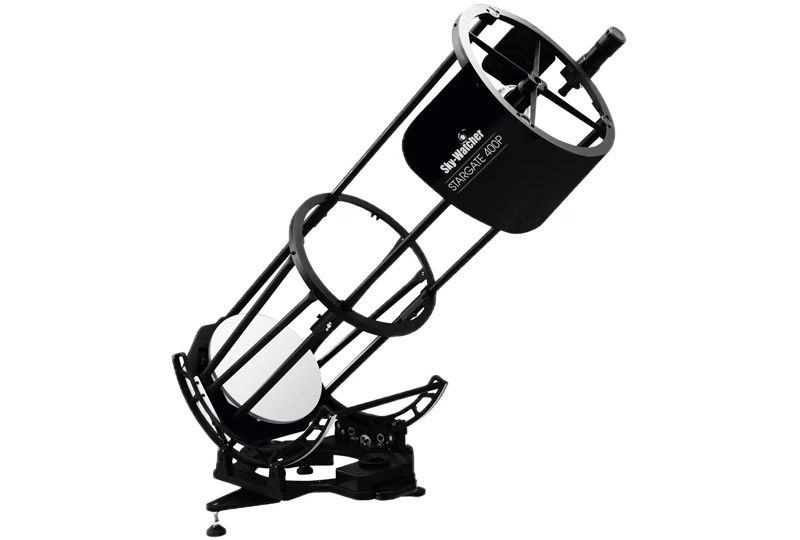
SkyWatcher_Telescope_Stargate-400P_10293A avec arrière-plan supprimé

On some Sky-Watcher Stargate motorized Dobsons, in particular the Sky-Watcher Stargate 400P GoTo, it may happen that the altitude drive belt gradually shifts as the telescope rises towards the zenith.

The symptom is fairly typical:

  • at low altitude, everything seems to function normally; ;
  • around 45°, the belt begins to shift; ;
  • close to 90°, it becomes clearly off-center; ;
  • In some cases, it may even partially emerge from the throat.

The problem can be worrying, especially on a 400 mm Dobson, but in many cases it's not a serious breakdown. Rather, it's a problem of alignment, belt tension or slight mechanical bending.

Observed symptoms

The observed behavior was as follows:

  • At 0° or close to horizontal, the belt seemed well centered.
  • At around 45°, it began to migrate laterally.
  • Around 80° to 90°, i.e. close to the zenith, the shift became very visible.
  • The belt came very close to the edge of a roller.

The fact that the problem increases progressively with altitude is extremely important for diagnosis.

This usually indicates a dynamic misalignment the system appears aligned at rest, but under load the structure works slightly as the tube rises towards the zenith.

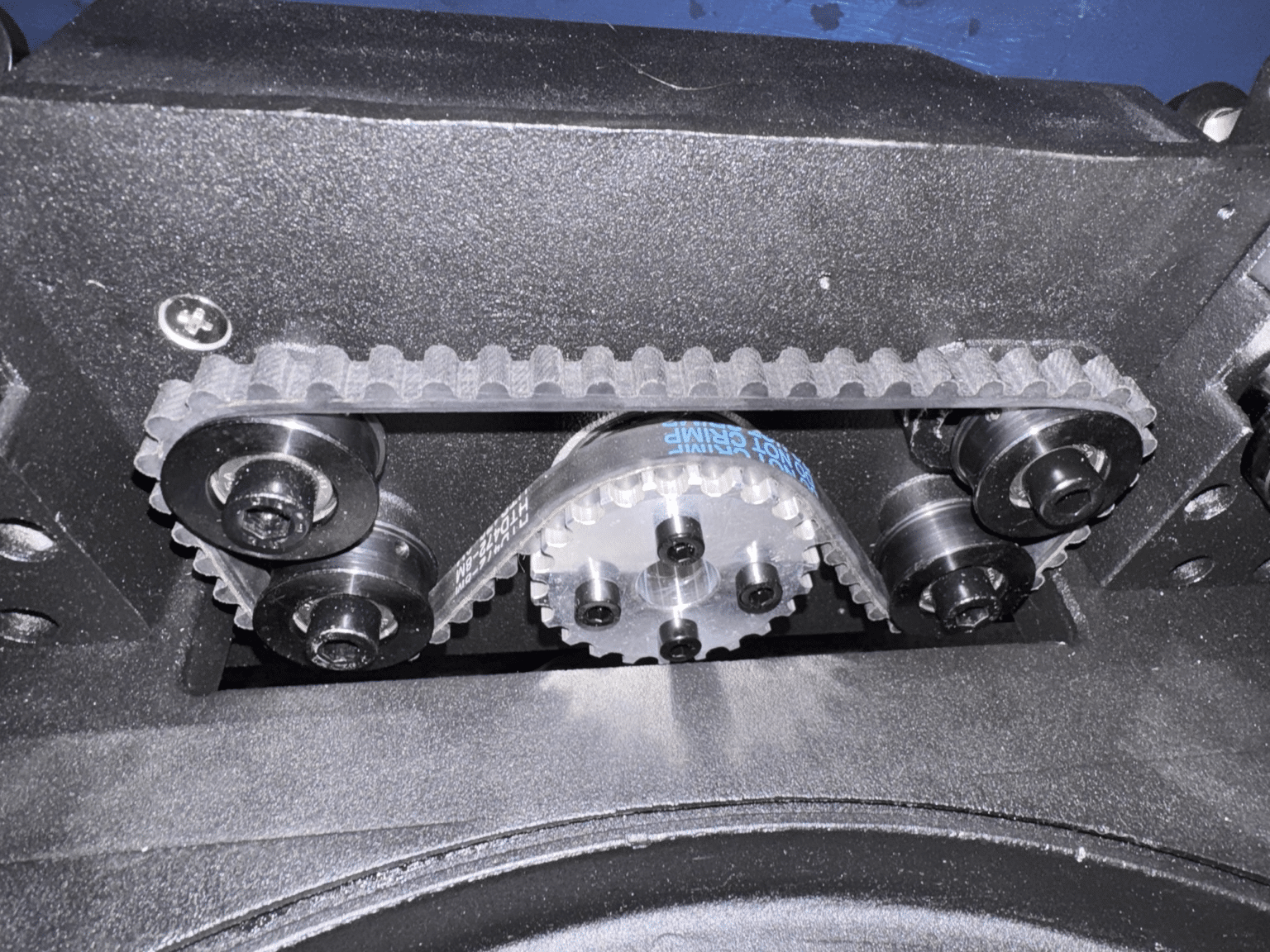
Photo of belt system

mechanism

At first glance, everything may seem perfectly normal:

  • the belt looks clean; ;
  • the pebbles seem to be in good condition; ;
  • nothing seems broken; ;
  • the transmission works.

However, on a belt drive, even the smallest defect can cause lateral migration.

Why does the belt shift at the zenith?

On a large 400 mm Dobson, mechanical stresses change dramatically with tube altitude.

When the telescope is pointed at the zenith :

  • weight acts differently on the trunnions; ;
  • the motor support may bend slightly; ;
  • the tension applied to the belt changes; ;
  • the rollers can be set at a very slight angle.

And that's the point: a shift of less than a millimetre can be enough to cause a timing belt to gradually migrate.

There are many possible causes:

  • a slightly misaligned pebble; ;
  • a belt that is too tight; ;
  • a bearing with slight play; ;
  • an incorrectly positioned spacer ;
  • slight bending of the motor mount ;
  • a pulley that is no longer perfectly parallel.

The very important role of belt tension

In this case, belt tension probably played a major role.

Intuitively, you'd think you'd have to tighten a belt to avoid backlash. However, on the Stargate 400P, this is generally not a good idea.

Why?

Because :

  • the belt is wide; ;
  • many teeth are in contact; ;
  • the transmission surface is large ;
  • the torque transmitted remains relatively low.

Excessive tension, on the other hand, can :

  • increase lateral stress ;
  • accentuate geometric defects; ;
  • make the rollers work crooked; ;
  • promote derailment.

A slightly less taut belt is better able to absorb minor mechanical faults.

Step 1: Observe belt altitude

The first test simply consists of observing the behaviour of the belt at different angles:

  1. Near-horizontal tube.
  2. Tube at approximately 45°.
  3. Tube close to zenith.

If migration increases progressively with altitude, the problem is probably related to the structure or alignment under load.

Step 2: Check the rollers

After disassembly and inspection, the lower roller appeared to be slightly offset.

The offset was small, almost hard to see with the naked eye, but on a belt drive it can be enough to cause continuous migration.

Check that :

  • parallelism of rollers ;
  • the presence of washers ;
  • bearing condition ;
  • no axial play ;
  • condition of spacers; ;
  • tightening screws.

Step 3: Slightly slacken the belt

The most effective test was to reduce the belt tension slightly.

To do this:

  1. Slightly loosen the idler.
  2. Gradually reduce tension.
  3. Do not make the belt soft.
  4. Re-test tube movement.

The result was an immediate improvement in symptoms.

The belt remained slightly offset, but its tendency to run out was greatly reduced.

Should you aim for perfect alignment?

Not necessarily.

On a large Dobson GoTo locksmith, there is always:

  • microflexions ;
  • mechanical tolerances ;
  • a little elasticity; ;
  • load-dependent variations.

The most important thing is :

  • that the belt remains engaged; ;
  • that she doesn't jump out of her teeth; ;
  • that it doesn't come out of his throat; ;
  • that the follow-up remains good; ;
  • that GoTo movements remain fluid.

Slight lateral migration may be acceptable as long as it remains stable.

When should you really worry?

The problem becomes serious if :

  • the belt jumps off the teeth; ;
  • it rubs strongly; ;
  • she's out regularly; ;
  • monitoring becomes irregular; ;
  • GoTo loses precision; ;
  • a mechanical noise appears.

In this case, consider :

  • a complete realignment ;
  • replacing a roller ;
  • bearing replacement ;
  • or improved lateral guidance.

Conclusion

On the Sky-Watcher Stargate 400P, an altitude belt that shifts towards the zenith does not necessarily indicate a serious malfunction.

In this particular case, the problem seemed to stem from a combination :

  • a very slight misalignment; ;
  • and belt tension probably too high.

Simply reducing the voltage has already significantly improved the system's behavior.

Before replacing any parts, it is therefore advisable to :

  1. observe behavior according to altitude; ;
  2. check the rollers carefully; ;
  3. check tension ;
  4. and gradually test the settings.

On this type of drive, extremely small differences can have a major impact on belt behavior.

Subscribe to our newsletter

By subscribing, you agree to our Privacy Policy.
Share

80 % of what you need to know to get the most out of your telescope

Sign up for our newsletter and receive free training!

Newsletter
[category_menu_mobile]