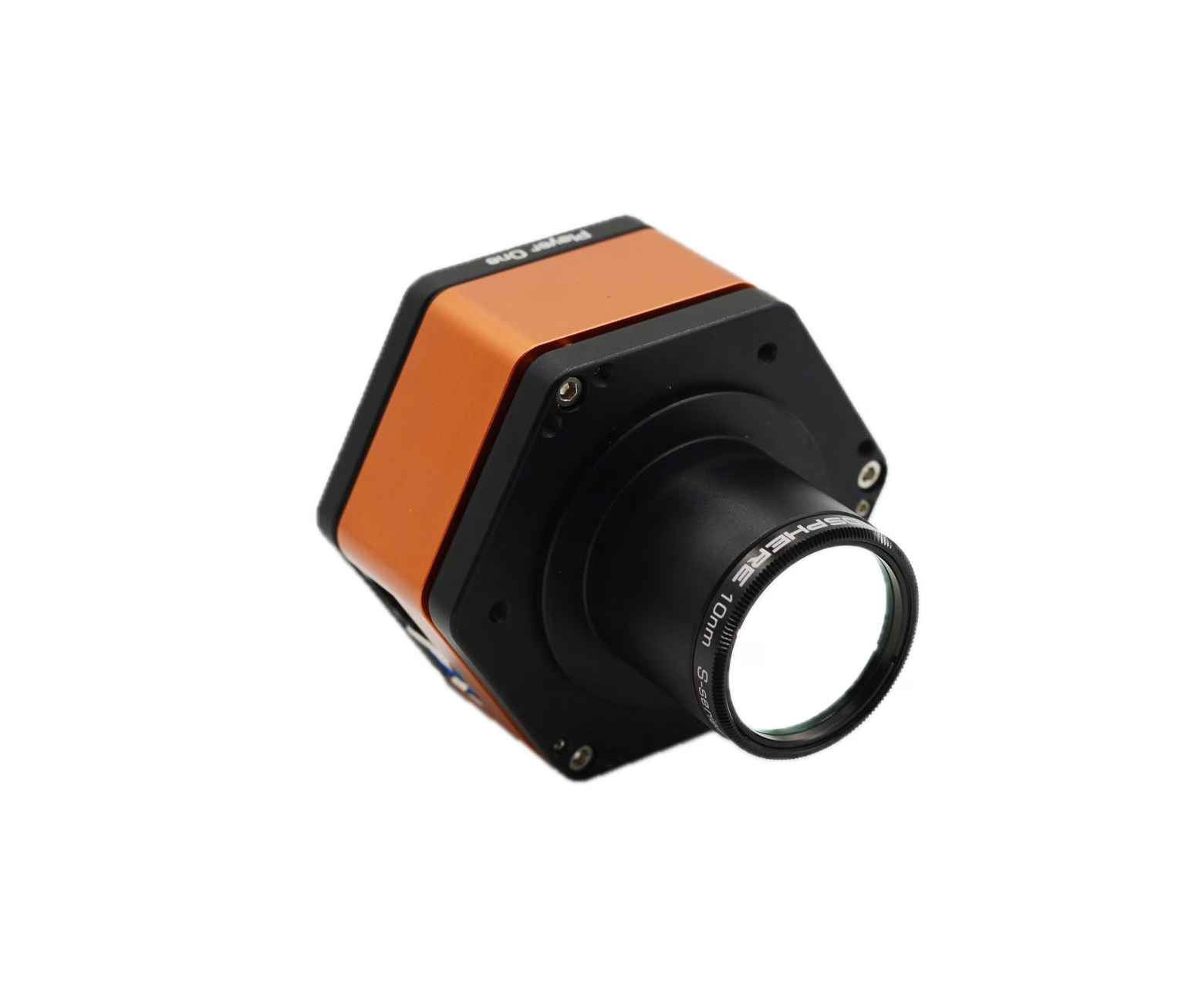
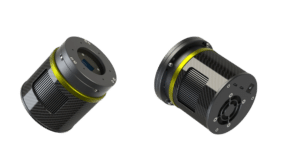
The Apollo-M MAX camera from Player One Astronomy represents a major advance in solar and planetary imaging. Designed specifically for day and night observations, this monochrome camera incorporates innovative technologies to meet the requirements of both amateur and professional astronomers.
Fundamental technical data
Sony IMX432 sensor and optical performance
The Apollo-M MAX uses a 1.1-inch monochrome Sony IMX432 sensor (17.5 mm diagonal) with 9 µm pixels. This exceptional pixel size enables a full-well capacity of 100,000 electrons (100Ke), four times greater than that of standard third-generation Pregius sensors. The 1.7 MP (1608 × 1104) resolution offers an optimum balance between detail and acquisition speed.
The sensor exploits third-generation Pregius technology, but features a unique architecture adapted to solar imaging. Unlike conventional Pregius sensors (4.5 µm and 25Ke), the IMX432 maximizes sensitivity and dynamic range for bright objects like the Sun.
Speed and data processing
In USB 3.0 mode, the Apollo-M MAX reaches 126 frames per second (FPS) in native resolution with 10-bit encoding (RAW8), and 109 FPS in 12-bit (RAW16). This speed is supported by 256 MB of DDR3 memory, reducing frame loss and stabilizing data flow even on USB 2.0 ports. Data transmission remains smooth thanks to an integrated cache and advanced read noise management.
Exclusive innovations for solar imaging
Artifact suppression and global shutter
One of the major challenges in solar imaging is the appearance of horizontal banding when using sensors such as the IMX174. The Apollo-M MAX eliminates this problem thanks to its global shutter, guaranteeing banding-free images even when mosaicing or in regions of interest (ROI). This feature is crucial for capturing fine details such as photospheric granules or chromospheric prominences.
HCG mode and noise reduction
HCG (High Conversion Gain) mode activates automatically when gain exceeds 145, lowering read noise to 4.6 electrons while maintaining high dynamic range. At a gain of 380, noise drops to 2.6 electrons, surpassing the performance of the IMX174. This flexibility makes it possible to adapt sensitivity to observation conditions, whether in white light or H-alpha.
Passive and active cooling
Often operating in daylight, the camera dissipates heat via a conductive passive cooling system (PCS). For precise control, the optional Active Cooling System (ACS) maintains the temperature at just 7°C above ambient, preventing overheating even during prolonged sessions.
Practical applications and results
White light imaging
With a Player One Photosphere 10 nm filter, the Apollo-M MAX reveals photospheric details such as sunspots and granulation. A notable example is an image taken with a SkyWatcher 150 APO telescope, showing exceptional resolution thanks to the large pixel and low distortion.
H-alpha observation and protuberances
Coupled with a Quark Chromosphere filter, the camera captures chromospheric structures and protuberances. Tests with an Explore Scientific 127 APO and a SW150APO+Quark demonstrated its ability to resolve filaments and flares with high contrast. The addition of a 1.25" ERF filter protects the sensor and enhances component longevity.
CaK line imaging
In collaboration with a Calcium K module, the Apollo-M MAX makes it possible to study the lower chromosphere layer. An image taken with a Lunt 152 illustrates the sharpness and richness of detail at this wavelength.
Ergonomic design and accessories
Sensor tilt plate
The integrated tilting plate corrects Newton's rings generated by interference in telescopes with protuberances. This innovation eliminates artifacts without compromising field curvature.
Compatibility and recommended accessories
- ACS (Active Cooling System): Improves thermal stability for sessions lasting several hours.
- Solar filters: Baader AstroSolar or Herschel Wedge for safe observation (mandatory to prevent damage).
- Filter wheels: Optimize wavelength changes without moving the camera.
Advantages over IMX174
The Apollo-M MAX surpasses the IMX174 in several respects:
- Pixels 1.5 times larger → Better adaptation to long focal ratios (e.g. Daystar 4.2X).
- Triple well capability → HDR imaging of the Sun and Moon.
- Lower reading noise → Optimum detection of low-contrast protuberances.
- No banding → Simplified post-processing and detail preservation.
User testimonials
Astronomers emphasize its effectiveness:
- "The best H-alpha camera for long focal lengths" - Mehmet Ergün.
- "An essential upgrade for lucky imaging" - Dennis.
- "Outstanding results with a Quark Chromosphere" - Efrain Perez.
Conclusion
The Apollo-M MAX sets a new standard in solar imaging, combining speed, sensitivity and robustness. Its technical innovations, such as the global shutter and HCG mode, make it an indispensable tool for demanding observers. Whether studying the photosphere, prominences or flares, this camera offers versatility and image quality unmatched in its class.