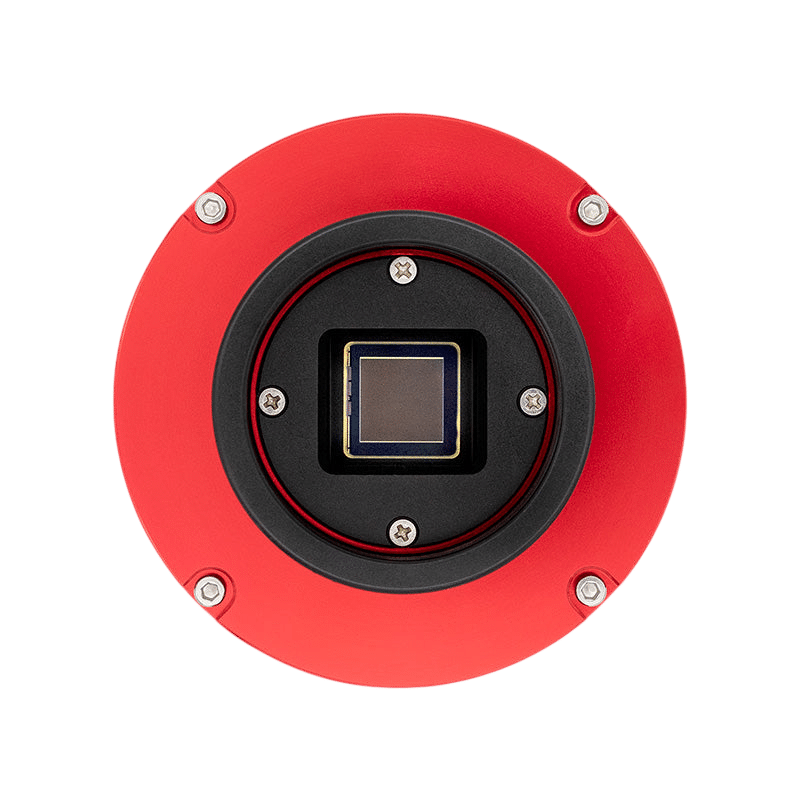
ZWO ASI533MM Pro: A square sensor for creating images using filters
The ASI533MM Pro features a monochrome channel centered on a square format: its Sony IMX533 sensor measures 11.31 × 11.31 mm and has 3008 × 3008 pixels. This framing is particularly well-suited for compositions centered around a central object, such as a compact nebula, a cluster, or a galaxy whose surroundings fit within the instrument’s field of view. It does not replace a large rectangular sensor for wide-angle panoramas; a field simulation remains the best way to verify whether a target requires a mosaic.
A format that changes the way you frame your shots
The square format provides the same horizontal and vertical field of view. This means you can compose an image without having to choose between landscape and portrait orientation, although rotation is still useful for positioning structures and stars. Its relatively compact image area requires a more central portion of the image circle than a full-frame sensor. This does not eliminate the need for sensor correction and perpendicularity, but it avoids requiring the lens to cover a large diagonal. The 3.76 µm pixels must be considered in relation to the focal length and typical turbulence conditions.
Select "Monochrome" to control each channel
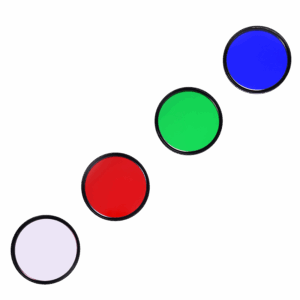
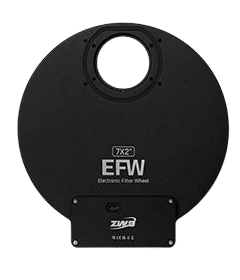
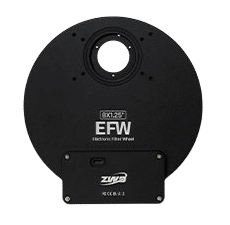
The MM version does not directly produce a color image. It records successive exposures through the selected filters, and the channels are then combined during processing. This allows you to allocate time separately to luminance, red, green, and blue, or to prioritize certain emission lines using appropriate filters. For a project spanning multiple nights, prepare a list of channels and maintain a consistent framing. A filter wheel and filters are part of the optical train you’ll need to include depending on your method; their inclusion should not be assumed based on the product line illustrations.
A sensor background without amp-glow—not without calibration
ZWO announces amp-glow-free electronics for the ASI533MM and MC Pro. This feature eliminates the unwanted glow caused by the electronics during long exposures and simplifies background processing. It does not eliminate dark current, defective pixels, dust, or illumination gradients: darks and flats remain essential. The spec sheet lists a maximum capacity of 50,000 electrons, 14-bit conversion, and a peak quantum efficiency of 91 % for the monochrome version. This last figure does not represent uniform sensitivity across all wavelengths.
Set up a reproducible configuration
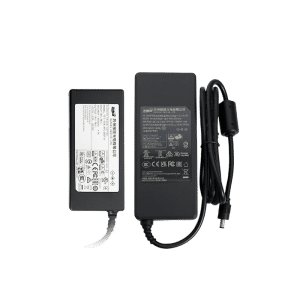
The two-stage thermoelectric cooler achieves a specified temperature difference of 35 °C below ambient in a test at 30 °C. The achievable temperature difference depends on the conditions; most importantly, choose a temperature that the camera can maintain without operating continuously at its limit. An external 12 V power supply rated at 3 to 5 A is recommended, with a 5.5 × 2.1 mm connector and center-positive polarity. USB 3.0 is the data connection; it is not a replacement for this power supply.
This camera is therefore designed for astrophotographers who want to learn or practice methodical monochrome imaging in a square field of view, rather than immediately capturing color images in a single series. Check the total optical path length, including filters and adapters, before assembling the system: the sensor’s small size does not mean you can ignore the required correction distance.
Documentation and Compatibility: ZWO official data sheet.