Telescopes

Brand
Filters by marque with category
See more
Subcategories
Filters By Categories in category
See more
Price
Filters by price - slider
0 CHF - 48857 CHF
Availability
Filters by availability
Specifications
Frequently asked questionsClick to view themTap to view them
I'm just starting out: Which telescope should I choose for my budget?

Before discussing which model to choose, there are four key factors to consider: your budget, whether you want to start by observing through the eyepiece (which is what we recommend), the space you have to store it, and the ability to transport it by car to a darker sky. For about 700 CHF, the Dobson Skyliner 200 mm Classic It's hard to beat: a true diameter, beautiful planets, a bright, deep sky—and there's still room to add a collimation laser, a good eyepiece, and a filter. If space is the main consideration, the Heritage-150P folds down to 42.5 cm.

Is it possible to have a single telescope for planets, nebulae, and photography?

For visual observation, yes: a 150- to 200-mm Dobsonian telescope works just as well for viewing planets as it does for bright clusters and nebulae. Deep-sky photography, however, requires precise tracking on an equatorial mount—something a Dobsonian cannot provide. Rather than a compromise that does both halfway, we recommend one instrument for visual observation and, when the time comes, a setup designed specifically for photography. To get started with photography without any hassle, a smart telescope like the Dwarf Mini point, track, and process images from your smartphone.

What will I actually see through the eyepiece?

With a 150 mm lens: Jupiter’s cloud bands and moons, Saturn’s rings, a wealth of detail on the Moon, star clusters, and bright nebulae. The planets remain small, and most galaxies appear as pale gray spots: the colorful images you see online are long-exposure photos; the human eye does not perceive these colors. But realizing that you’re observing these objects with your own eyes evokes a feeling that far surpasses that of a color photo. A sky free from light pollution and a little practice with the eyepiece make a world of difference.

Which telescope is best for a child or for family stargazing?

Avoid small «toy» telescopes: they're expensive for what they show, and they quickly lead to frustration and giving up. For a family or a teenager with a passion for astronomy, a 150-mm model like the Heritage-150P is a real instrument: compact, comes with two eyepieces (25 and 10 mm), and sits on a sturdy table. If your children dream above all of taking pictures, the Dwarf Mini It's very easy to get the hang of.

Dobson 150 or 200 mm: Is the difference worth it?

Yes, this is a real milestone: according to Sky-Watcher, the 200 mm is about 78 % brighter than the 150 mm, which is evident when observing galaxies, clusters, and planetary details. The difference in size is minimal: the Skyliner-150P and the Skyliner 200 mm Classic have the same focal length of 1,200 mm, which means a tube length of about 1.1 m in both cases, for just 3 kg more. If the tube length bothers you, consider a retractable tube like the Heritage-150P.

Note from Deep Space Astronomy: Our preferred diameter is 254 mm, like the Skyliner-250P Classic : It offers a wide field of view and remains the largest portable Dobsonian telescope.

Does the telescope come ready to use?

Yes: the Skyliner-150P and the Skyliner 200 mm Classic come with a finder scope, two wide-angle eyepieces (20 and 12.5 mm, 70°), and a smartphone adapter—everything you need to enjoy your first few nights of stargazing. A reflecting telescope needs to be realigned from time to time, especially after being transported; a collimation laser makes this adjustment quick.

Which smart telescope should you choose?

They all point, track, and stack images on their own. Three factors set them apart: the diameter, which determines the amount of light captured; the focal length, which determines the size of objects in the image; and the weight, which determines whether you’ll actually take it out.

  • Dwarf Mini : 30 mm, 150 mm at f/5, field of view 2.14° × 1.20°, 840 g. The most portable model, ideal for beginners, travel, or observing with children; equatorial mode with exposure times up to 90 seconds on a tilting tripod.
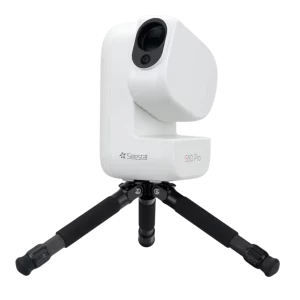
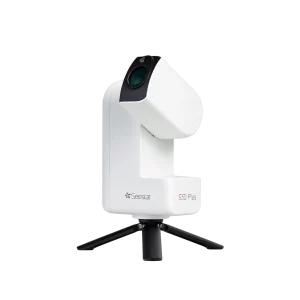
  • Seestar S30 Pro : 30 mm, 160 mm, 8.3 MP sensor, 4.6° diagonal field of view, 1.65 kg. The widest field of view: the entire Andromeda Galaxy, the large nebulae in Cygnus.
  • Seestar S50 Pro : 50 mm, 260 mm, 8.3 MP, 2.8° diagonal field of view, 2.8 kg, up to 9 hours of battery life. 2.8 times more light than a 30 mm lens: the best all-around compromise.
  • Unistellar Odyssey Pro and Equinox 2 : 85- and 114-mm mirrors, field of view approximately 34′ × 45′, barely larger than the full Moon. Galaxies appear larger, but Andromeda does not fit in the field of view. 4 and 7 kg; the Odyssey Pro features an electronic eyepiece developed in collaboration with Nikon.
  • Celestron Origin MKII : 152 mm RASA at f/2.2, 8.3 MP sensor, field of view 1.32° × 0.75°, total weight 18.9 kg. A small observatory for the garden that accepts 1.25″ or 2″ filters.

Keep in mind that a smart telescope does not replace an eyepiece: it displays a processed image on a screen. For visual observations and planets, a Dobsonian telescope is still unbeatable; the two complement each other very well.

Note from Deep Space Astronomy: Whether you're just starting out, with your family, or traveling, the Dwarf Mini is our top pick; pair it with a tripod to take advantage of equatorial mode. If you’re looking for a single telescope that will last you a long time, go for the S50 Pro. With a backyard, decent skies, and a desire to see real galaxies, the Origin is in a league of its own.

Dwarf Mini
Price range: CHF 345.00 through CHF 429.00
Our favorite smart telescope here at DSA!
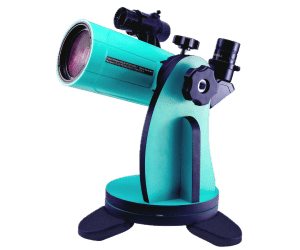
Acuter MaksyGo 60 – Mini Dobson Maksutov-Cassegrain
CHF 119.00
The best entry-level model—the star of Christmas!
Sky-Watcher Skymax-180 PRO (f/15)
CHF 1'199.00
Always in focus, excellent for planetary photography
Sky-Watcher Skyliner-150P
CHF 329.00
Perfect for getting started
Sky-Watcher Dobson Heritage-150P 6"
CHF 319.00
Excellent 150mm—a guaranteed connection to the sky
Sky-Watcher Dobson Heritage-100P  4"
CHF 189.00
A real telescope, used by the team
Dobson Bresser Messier 6" (150mm) - Version planétaire
CHF 399.00
We like it because it comes with plenty of accessories
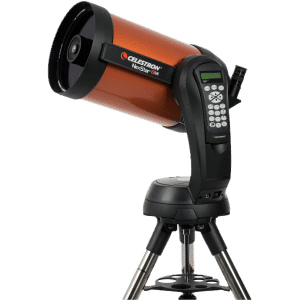
Celestron Evolution C9.25" SCT Wifi
Original price was: CHF 3'199.00.Current price is: CHF 3'099.00.CHF 3'199.00
[category_menu_mobile]